Our Great Mediocrity - 4
"My son Behçet, do you know what the bankruptcy of a civilization is?"
Ahmet Hamdi Tanpınar, Mahur Beste, p. 118
In the series of essays titled "Our Great Mediocrity," which we began by searching for ways to earn without labor, we continued with our underdeveloped brand of street-hustling, discovered the concept of labor through our brilliantly innovative idea of manufacturing dog bowls, and sketched out, from the grimy garages in front of our houses, a panorama of the birth and reproduction of a culture of mediocrity. Along the way we had found added value, given up hope on flipping-and-trading, learned what capital actually is, and finally deduced that the anguish of visionlessness we suffer from is a symptom of a deficiency in deepened interests.
In the pages that followed, we argued that the culprit behind this deficiency symptom was an addiction to urgency and easy shortcuts, lamented our lives being lost between the short and long term; and couldn't help but ask: "if our capital weren't so scarce, and if hopscotch on paving stones hadn't been our only entertainment in school, would we have fallen prey to this affliction at all?"
So now, starting from precisely this point — the scarcity of capital — we're going to think about why we can't produce goods that cost tens of thousands of dollars per kilogram, and why, far from producing them, we can't even conceive of the idea of producing them.
Since the beginning of this series, I've been trying to emphasize that we are mediocre in many areas. To put it more technically, I'm saying that our human capital is weak, deficient, and flawed. Yes, in my view, this is the crux of the matter. Human capital. So what is human capital?
I'll start with the definition of human capital, then examine, one by one, the sub-headings that make it up in Turkey and in the world, and try to understand our standing globally.
Human capital, it turns out, refers to the sum of knowledge and skills held by the workforce. Various studies have shown that societies made up of educated and healthy individuals accelerate both socio-cultural development and economic growth, while also enabling existing resources to be used more efficiently.1.
Another study identified a positive correlation between human capital and economic development. Moreover, according to the author, while no bidirectional causal relationship was found between exports and human capital, between human capital and fixed capital accumulation, or between fixed capital and economic growth; one-directional causal relationships were, in addition, observed in the short run — from fixed capital accumulation to exports, from exports to economic growth, and from economic growth to human capital. The same article also showed that human capital positively affects economic growth by stimulating total factor productivity.2.
According to Wikipedia, human capital fundamentally has 6 components:
- Intelligence
- Health
- Quality of education
- Foreign language proficiency
- Socioeconomic environment
- Emotional intelligence, creativity
After all this preamble, we can begin examining the components mentioned above in the context of mediocrity and human capital.
Intelligence
Let's start with intelligence.
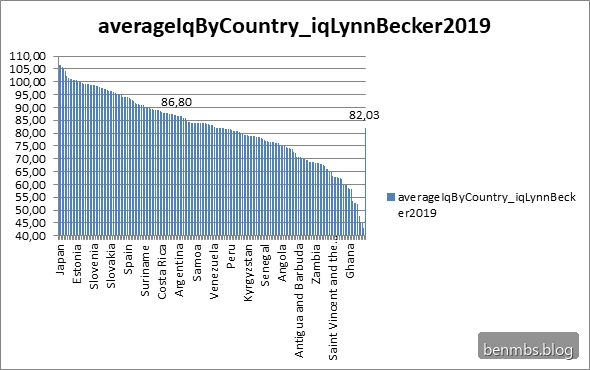
Research has found that, among 200 countries, the highest average IQ belongs to Japan at 106.48, and the lowest to Nepal at 42.99. According to the data obtained, while the world average was calculated at 82.03, Turkey came in at 86.8 points — 5% above the average.3.
Ah, and here's the chart. Handcrafted with love (and eye strain).
After IQ, let's also look at the PISA results. PISA is a study conducted every 3 years since 2000, whose fundamental aim is to measure the knowledge and skills of 15-year-old students in reading, mathematics, and science across countries, and to assess how well they can apply this knowledge in the context of everyday problem-solving.
You can find the results of the 7 PISA tests conducted between 2003 and 2022, showing Turkey's ranking among OECD countries, in the table below4.
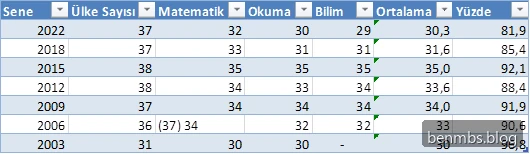
Out of the 20 total evaluation criteria we've participated in as Turkey, we've only ever managed to find ourselves in the bottom 20%. In other words, in the OECD ranking, we're not even mediocre — we're terrible. If we were merely mediocre, we'd need to be around the 50% mark or so.
One could say that OECD member countries are already relatively well-off. So what's our standing across the whole world? Not the whole world exactly, but according to the list of roughly 100 countries where PISA is administered, the results are as follows:
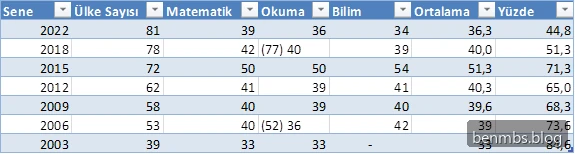
Looking at the table, we can see that Turkey has climbed in the rankings since the test was first administered in 2003. In 2003, it was in the bottom 15%; by the most recent round in 2022, it had reached the 50% mark. If I had to give this table a name, I'd probably call it "From Terrible to Mediocre." Yes, according to the 2022 results, we're mediocre. Let's celebrate.
Quality of education
PISA test results also measure quality of education. I won't repeat that data here to avoid redundancy. Instead, we'll try to draw conclusions from the most basic metric here: average years of schooling.
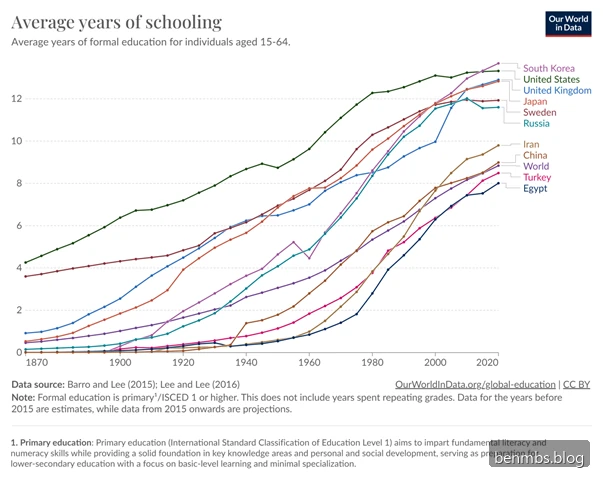
The chart shows the average years of schooling for the 15–64 age population of certain countries between 1870 and 2020. According to this chart, our average schooling duration for the 15–64 age range is 8.5 years, while the world average is 8.8 years5. In other words, our average schooling duration is below the world average. Of course, one could object to this data by saying: "our young population is larger than that of many countries. Someone who is 15 will have had a maximum of 9 years of schooling. So this chart is misleadingly comparing countries under different conditions." I should first say that I agree with this argument in one sense and disagree with it in another. Yes, our average comes out low because of our population structure. If it's the active population that will develop the country, then of course comparing that group would be more accurate — say, the 25–60 range. But the chart wasn't designed with the purpose of saying anything about our human capital 10 years from now. The chart gives us data about countries' current human capital. Looking at this chart, we can even get a sense of who's coasting on whose back.
But alright, for your sake, let's also look at World Bank data6. The World Bank compared the 25+ age population. According to the data from their most recent measurement, in 2017, our average schooling duration for people over 25 was 8.17 years.
We've shown an average annual increase of 0.15 points. If we hypothetically extend the World Bank's missing 3 years of data forward to 2020 — the last data point in the chart above — our average schooling for the over-25 population in 2020 would come out to 8.67 years. So, while our average schooling duration is 8.5 years according to the 15–64 comparison, it's roughly 8.67 years according to the 25+ data. There doesn't seem to be a serious difference between the two.
If our average schooling duration keeps increasing at this rate, our average for the over-25 population will reach 13.67 years by 2053 — meaning that in 30 years, we'll be able to catch up to where South Korea stands today.
To make the chart easier to read, they've also provided it as a list:
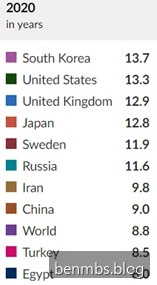
Anyway, let's get to the point. I picked the countries at random. You know what's funny? I didn't know this before looking at the chart either. We're nearly at the world average in education too. It's almost a joke. We turned out mediocre here as well, apparently.
So, my friend, in a country that's mediocre by world standards and terrible by OECD standards on tests measuring the academic abilities of students currently in school, in a country whose average schooling duration is just a bit over 8 years — what human capital are we even talking about?
Foreign language
The chart below shows the EU's foreign language proficiency survey. It gives, as percentages by country, the share of people who don't speak a foreign language and those who speak between 1 and 3 languages7.
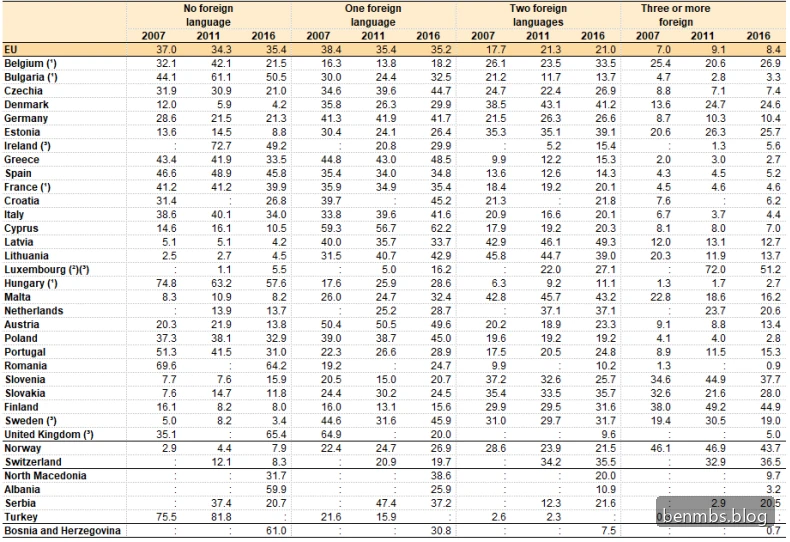
Since 2007 is the only year for which Turkey has data across all 4 criteria, I'll compare our 2007 figures with the EU's.
Don't miss new posts
Join the email list and hear about new writing as it lands.
According to the EU's research, the rates of foreign language knowledge and lack thereof in 2007 were as follows:
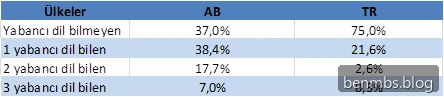
According to the chart, roughly only 1 in 3 people in EU countries doesn't know a foreign language, while for us it's 2 out of 3. In other words, we've doubled the EU's ignorance rate. Our rate for knowing 1 foreign language is almost half the EU's. As for knowing 2 or 3 foreign languages, the gap between us and the EU is at a scale where calculating it becomes pointless.
As noted in the article containing these results, a considerable portion of Europeans don't live in their own country. Another factor is that many countries have several official languages. Yet another is the existence of different dialects within some countries… And a completely separate factor is that marriage to a citizen of another European country is common. And one more reason, not mentioned in the article but easy enough to guess, is that European languages come from a shared family, making it easier for someone who knows one at a native level to learn another, compared to us. Factors like these explain why Europeans know more foreign languages. But what I want to show with this research isn't that Turks have a weak ability to learn or teach foreign languages, or anything like that. What I'm trying to do here is analyze an existing situation. For whatever reason, these people know more than one language and we don't. As a result, we're deprived of the benefits of knowing multiple languages. And that makes us deficient in this area.
Unfortunately, I couldn't find world data on foreign language knowledge.
Socioeconomic environment
Under this heading, I want to examine the economic mediocrity we find ourselves in. Let's set aside the "social" part of "socioeconomic" for now.
In Burak Su's piece titled Can We Make Turkey the World's 15th Largest Economy Without Building a Single Factory?8, there was an analysis I liked. He looked at countries' contributions to the world economy relative to their share of the world's population. In doing so, his goal was to find how many units of contribution to the world economy each unit of population produces. According to his analysis, 1 American's contribution to the economy is 6 units, 1 Chinese person's is 1 unit, and 1 Indian's is 0.2 units. When we get to Turkey, our contribution to the world economy is 1%, and our population also makes up 1% of the world's. In other words, our economic contribution ratio is 1-to-1. We're the same as China.
I'd like to revise this method in my own way and present it.
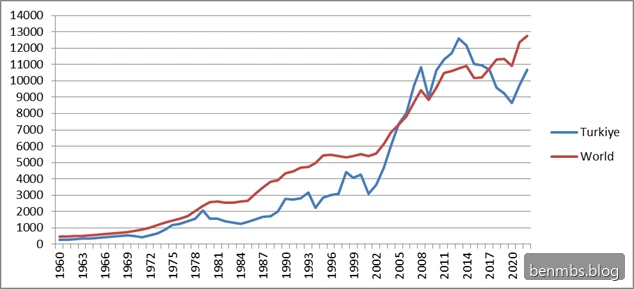
Economic historians will, of course, read these dates better than I can, but from a rough look at the chart, we can say the following: our average per capita income has tracked almost parallel to the world's for most of the time. During periods like the coups and economic crises the country went through in 1969–71, 1980–82, 1999–2001, and 2016, we diverged negatively from the world average.
The first year we diverged positively from the world average was 2005. From 2005 to 2016, we tracked above the world average.
The year we've been furthest below the world average, to date, is 1994, at 0.45 times the average; the year we've been furthest above it is 2013, at 1.17 times. In other words, at most, we've managed to exceed the world average by 17%. In our worst year, we didn't even reach half the world average.
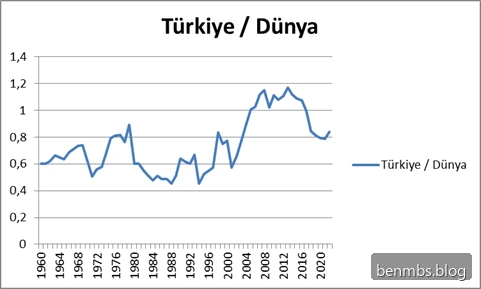
And here's another representation of the same chart.
And here's the chasm between us and the OECD countries:
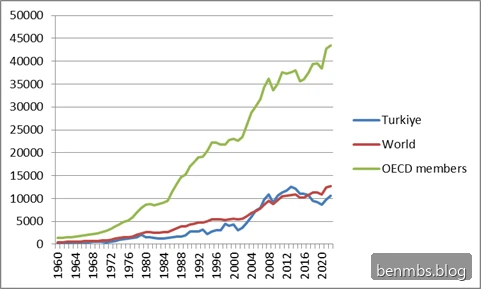
Whatever the OECD countries did, even though they've always been above the world average, they've diverged from it logarithmically since the 1970s. And today, the OECD has an average income more than 4 times ours.
Conclusion
Looking at the few charts above, we can see clearly what materials we're working with. I wasn't able to compare and evaluate data on emotional intelligence, creativity, or health in this piece. That's one of its shortcomings. But even with the data at hand, there are still some conclusions we can draw.
In IQ and PISA tests, we're playing the role of mediocre by world standards and terrible among OECD countries. In average years of schooling, we're a good way behind many countries. Our national average is a primary-school graduate. Three-quarters of the country doesn't know a foreign language. In average per capita income, over the past 60 years we've only managed to represent the average for 10 of them; for the other 50, we've been below it. And with the OECD countries, the gap between us can only be assessed on a logarithmic scale… In other words, we are less educated than the rest of the world, more ignorant than the rest of the world, and poorer than the rest of the world.
So what are the causes of this? According to an article I cited earlier, economic growth triggers human capital, and human capital triggers economic growth. As we've seen, our human capital is weak. As a result, our economy also stays weak. And vice versa… We haven't managed to diverge positively from the world in any area. We've walked right down the middle, together with the herd. As a result, we haven't managed to produce any breakthrough that makes a real difference economically or culturally. Whatever breakthroughs have occurred happened in spite of this environment. So what's the solution? The solution: improve human capital and the economy. I've given away the secret. We can all go home now.
Burak Su, whom I cited in this piece, proposed branding as the relatively low-cost way to improve the economy. In short, he was saying: let's increase our market share by increasing our brand value, and let our income grow. Is this a solution? Even though it looks like one, I'm of the opinion that the kind of branding he's talking about can't actually be achieved with this human capital. Even if it is achieved, it can only happen in spite of this human capital.
For a long time now, our one world-famous brand has been Turkish Airlines, and recently a few brands have emerged in the defense industry too. In other words, we have a limited number of brands, and even those grew by force of the state. Beyond that, expecting such success from individual entrepreneurship seems to me like a futile, endless wait. Because I've already written this throughout the series. Given all this, how could a value-added product possibly be produced amid so much mediocrity? Let's say some madman decides to set out and create value — would this many mediocre people even recognize the value of that value? Would they support it? Forget support — would they even stop being an obstacle to it? I doubt it.
At the very beginning of this piece, I referenced the first essay in the series. Whoever has a bit of money builds real estate. Why? Man, is he crazy — why would he set up a factory? The exchange rate has run off on its own, with neither the inputs nor the outputs certain. Is there going to be a coup tomorrow? Will his eminence appoint a state trustee to run the factory? Will the plot of land you bought to build your factory get its zoning revoked because you didn't grow a beard for the district chairman? Which problem would you even choose to deal with? If I had 10 million dollars, would I set up a factory in a country with an uncertain future, or build a villa? I'd probably build a villa. Or transfer a chunk of it to Switzerland and build a villa with the rest.
That's the part of this that's somewhat within my control. There's also the part that isn't. Man, swing your arm around in this country and you'll hit someone who's only a primary-school graduate. Millions of people haven't set foot in a movie theater even once in their lives. Reading rates aren't said to be terrible, but the vast majority of what's read is cheap pulp fiction… The most-watched videos on YouTube are dumb, nonsensical, so-called comedy clips. No one has ever taken anything they've started all the way through to the end; no one has picked up even the smallest hobby. Just as our country sits at the world average, our citizens too lack the qualities that would set them apart from the herd. And because the citizens are deficient, the country is deficient. To do the things I'm talking about, you need to break away from the herd and avoid being caught by the wolf. And with us, whoever has managed to break away from the herd has been snatched by the wolf. So what did you expect???
So now let's come to you, dear reader;
You, who spent years calling Erdoğan a dictator and yet today vote like sheep for whoever the CHP nominates, who go rabid over the İYİ Party fielding its own candidate, who saddled us with some talentless figure as a "democratic elder statesman" and still want him propped up in his seat and defend him — do you really think you're any different from the people you criticize?
Or you, dear reader;
You, who spent years whining about being victims, and then, the moment you got your hands on power, trampled all over the constitution and declared anyone you didn't like a terrorist, who never learned or tasted what freedom is, who never even heard the word "liberty," who treat every criticism as an attack or a betrayal, who consider thinking differently to be treason — do you really think you're any different from the copycats who stand at attention in a moment of silence at every random opportunity and declare their own sacred cows?
Man, don't come at me with "what does this have to do with CHP" or "what does this have to do with AKP." Our problem is a people problem. The cause behind so many things we encounter in everyday life is the premature human beings produced by our bankrupt civilization. If our human capital were sound, our politics would be sound too.
In short, whoever you are, don't think that just because you're reading this piece, you're somehow different. As the old saying goes: you're a lord and I'm a lord — so who's going to milk this cow?
M. Batuhan Şahin
02.02.2024
Bibliography:
References
Don't miss new posts
Join the email list and hear about new writing as it lands.
Mediocrity
- Our Great Mediocrity — 3
- Our Great Mediocrity - 4 (you are here)
- An Attempt to Transcend Mediocrity Through Islamic Thought
Comments (0)
Be the first to comment.