An Attempt at a Cultural Autopsy of Japan, or Travel Diary 1: Introduction and Osaka
Landing: The first draft of this piece was actually put together about six months ago. But thanks to a number of things getting in the way (laziness, mainly), it's only now that its publication has finally come to pass. Once I was convinced I'd never manage to publish it as a single piece, I decided to release it in parts instead. I'd guess it will run to four or five installments.
- Introduction and Osaka
- Kyoto
- Tokyo
- Tokyo Mosque and Contact with Muslims
- General Impressions and Final Notes
Preliminary note: This piece is not, strictly speaking, a Japan travel guide. I'm no seasoned traveler, and there are already plenty of vlogs and blogs that do this sort of thing more professionally and present it far better. I'll mention a few of them later on. In keeping with the concept of this blog, this piece will be built around my own subjective experiences and conclusions. It's not a great fit for anyone hoping to read about how to get somewhere, what to see, or wanting to look at photos of Japan. This piece is more an answer to a question like: what are the Japanese and Japan like, through Batuhan's eyes? Of course, since we will also talk about the places we visited and saw, I should note that the claim "this is not a travel piece" can't be entirely true either. Let's move on to the introduction.
Introduction:
According to my original plans, by now I should have published not just this piece but a great many others too — the Mediocrity series, for instance, should have wrapped up by now. But somewhere along the way, one wedding and one trip to Japan intervened, and after all of that a truly monumental bout of inertia and laziness, and I couldn't bring myself near the site for months. At first I waited, thinking I'd finish this piece before touching the others, and held them back. Then I noticed this piece showed no sign of ever finishing, so I started squeezing other pieces in around it. Anyway, because of these erratic, sudden events, both the Mediocrity series and my other writings fell a bit behind schedule, but I didn't lose heart, I held out, and on my honeymoon I even planned a new installment for the series: Japanese Mediocrity. No, not quite that far :). But yes, I do think I can be so bold as to say a few words about the Japanese. After all, on our honeymoon we went temple-hopping and racked up over two hours of voice recordings, marching through the streets of Japan like a couple of little Lawrences — that counts for something, doesn't it?
Yes, friends, I got married. I'll gladly take a blessing from you. As a wedding gift, feel free to subscribe to the site using the button below. Ehehehe.
Why Japan?
Anyway, we got married and said, let's go on holiday. We thought about what kind of holiday it should be. I said, ever since our grandfather the pasha's day, we've always gone to the seaside for our honeymoons — after all, what else would you expect from children of a country surrounded by sea on three sides who can't swim and have never so much as seen a fish? Another point we factored into our deliberations was the question of how feasible a beach holiday is while holding to Islamic sensitivities. It's possible, but how much of it, and at what cost? After a round of conversations along these lines, we killed the beach-or-water-holiday plan before it even got off the ground. And besides, we love a cultural trip, we're mad about a bit of sociological inspection, and we break into a run the moment we spot a museum — fine then, let's make it a cultural holiday. Let's go!
We said, we'll never have a holiday this long again, so let's go somewhere far, since a twelve-hour journey isn't worth it for a short trip. The options were Peru, Mexico, South Korea, and Japan. Bali, the white-collar favorite, was eliminated right away because of the beach-holiday issue. The Americas didn't pan out either, which left the East Asian countries. I told my wife, "I had a cousin who was obsessed with Korea, and I've bullied him about it for years; if the first country I ever go to turns out to be Korea, he'll bully me about it forever — let's not go there." Fine, we said, and the next thing we knew, we'd landed in Japan.
When I thought of Japan, the only thing that came to mind was the Arçelik robot. I kept an eye out for it everywhere, but we never once ran into it. Instead, we were greeted by temples, forests, humidity, heat, and strange cities. We decided it was fine not to see the robot after all, and in due course made it safely back to the homeland's soil, dear reader.
Japanese Belief
Yes, as I said, the only thing that came to mind when I thought of Japan was the Arçelik robot, and that's why, even if it was only a few days before we left, I had to do some research — and in the course of that research I learned quite a lot. For instance, I'd assumed these people were atheists, but it turns out they're not, not at all. They're Shinto and Buddhist, as it happens. I thought, hold on a second, what on earth is Shinto?
I did a bit of research on YouTube and, as far as I'm concerned, picked up enough to get by. If you're curious who or what these Shintos are, you can find the relevant videos on brother Bülent Şahin Erdeğer's playlist here:[1] https://www.youtube.com/playlist?list=PLZzV2gqYCPyuZIXhfFVUmHH-fbWn0Lpvz
I watched a few more videos and documentaries besides, but in my opinion brother Bülent gave the most thorough and clearest account. I watched the Shinto and Buddhist videos. I told myself I'd watch the Hinduism ones on the plane, but since I slept through all twelve hours, that never happened. I wish I'd watched them beforehand, starting from Hinduism, because apparently you really need to trace things back to Hinduism to properly understand Shintoism. If you're thinking, "who cares about their religions, bro, I just want to know about the Japanese," you're mistaken, because Shinto lies at the very foundation of these people's character and culture. You won't grasp this if you look at the Japanese without having watched the videos, but once you've watched them, you won't be able to look at them the same way again. I'm telling you this quite plainly.
Anyway, for those of you saying "quit stalling, get to the point," I can tell you that Shinto is the national religion of the Japanese. Many of their customs, the narratives in their manga, and certain characteristic traits (harakiri, for instance) actually trace back to Shinto belief. Their perfectionism, their overworking, the way their lives change after having children, and so on, all ultimately draw on Shintoism. Japan and the Japanese, created from the tears of a god (I think that was the metaphor; I can't recall the exact details now), are exalted beings. They work themselves to the bone so that no stain falls upon the honor of their family or of the great Japanese nation. Because there is, after all, an ontological bond between them and their god. One step further, and you're in fascist territory…
Shintoism isn't structured in a way that excludes other religions. A Shinto believer can also be Buddhist, or Christian, and so on. Shinto belief doesn't treat other faiths as "the other." In fact, the Japanese have a saying: we are born Shinto and buried Buddhist.
This faith doesn't have a ritual or concept of God like ours. Their ritual consists of going to a shrine and praying. Before praying, they perform a kind of ablution similar to our own wudu, bow toward the shrine, clap their hands, pray, and leave. The clapping, apparently, is meant to draw the attention of the kami and let them know they're being addressed. The kami, as they're called, is a kind of god, but not like ours — more a kind of force, a spiritual being responsible for certain specific things. The emperor is a kami, for instance. There's a kami of health, too. It's a sort of polytheistic yet, at the same time, godless belief system. I found it hard to grasp. I can't say I've fully understood it even now. Anyway, maybe we'll go into more detail on this elsewhere. In the meantime, do go watch brother Bülent's videos.
The itinerary:
We didn't put together our itinerary the way some people do — "at 5 o'clock we'll watch such-and-such from over there, we need to reach the temple before the sun's angle passes 65 degrees, strike this pose right here, and immediately after that try this dish at that restaurant." We mostly just marked the places recommended on Tripadvisor and travel blogs that caught our interest, and figured we'd pop into whatever else caught our eye along the way. And that's more or less what we did. We only really blew our schedule in Tokyo, and that came down to our own inexperience. God willing, Evliya Çelebi himself will give us his blessing on our next trip.
Anyway, once we'd sorted out the Shinto and Buddhist business more or less, what remained were questions like where to go, what to see, and how many days to spend seeing it. My main goal was to study the culture of these people, who belong to an entirely different culture from ours, to have a heart-to-heart with a Buddhist monk or two if possible, and to talk with Japanese converts to Islam. To that end, among the places I wanted to see were plenty of temples, and the Tokyo Mosque.
I read blogs, my wife watched vlogs. Something came out of it in the end. Along the way I also came across some lovely blogs. It was a nice find. The blogs I made use of[2][3]: oitheblog, elifinatlasi
After a series of skirmishes with my kind, courteous, understanding (as of now, former) boss, I managed to secure a two-week wedding leave, and we came up with roughly the following schedule:
- 1 day in Osaka
- 3 days in Kyoto
- 4 days in Tokyo
If you're wondering where the remaining six days went — well, are we not even allowed a wedding, my friend? The journey itself took a day, then a day of travel fatigue after getting back, three or four days for the wedding and all the fuss beforehand. Honestly, two weeks feels barely enough to me, but anyway.
The blogs I read were full of information and opinions that contradicted one another. Some people hated Osaka; others couldn't get enough of exploring it. Some said three days is enough for Kyoto; others said even thirty-three days would barely scratch the surface. As for Tokyo, people just couldn't get their fill of it — they went on and on describing it and touring it without ever really finishing. And since we've made a habit of parting ways with the general consensus on just about everything, naturally we managed to arrive at a verdict running exactly opposite the popular one here too.
Osaka, it turns out, is Japan's very old former capital. There are palace ruins and so on. We went to Osaka. There were a handful of touristy spots, so we went and saw them. We stayed one night, and the next day moved on to the other former capital, Kyoto. Kyoto apparently has 1,600 temples. If we visited one temple every hour and slept six hours a night, that's eighteen temples a day. We said, that's never going to end, and in the end we spent three days touring the place before arriving in the current capital, Tokyo. Actually, before reaching Tokyo, there are a few cities near Kyoto, like Kobe and Nara. We wanted to visit them, but when we pulled up on the map the places we were planning to see in Tokyo, we noticed they were scattered across entirely different areas — four districts in total. We said, we can barely manage Tokyo in four days as it is; if we stretch out Kyoto by a few more days, I won't have a job left when I get back — let's not turn this into the most expensive trip in world history, let's just follow the well-trodden path and spend four days in Tokyo. Fine, we said, left the deer behind in Nara, and set off for Tokyo. In the end, we ended up seeing everywhere we'd planned to see in four days in just two, and spent the remaining two days staring at the river, thinking about the deer we'd left behind in Nara, and fondly remembering my boss.
Thanks to this trip we learned something about ourselves: we're not really city people. And we already live in Istanbul, of all places. How many times have I actually gone out and had a good time in Bebek, Nişantaşı, or Beşiktaş? How many times a year do I even go shopping at a mall? When I got home and started putting my wardrobe in order, I noticed I had three or four shirts (two of them bought for the wedding and the engagement), four or five t-shirts, and three pairs of trousers. Surely a man with a genuine passion for mall-hopping wouldn't have a wardrobe like that?
As for electronics stores — sure, tech products are cheap there, but I have no real interest in technology, nor any real knowledge of it. What would I even do with any of it? If truck tires got cheap, would we buy those too? If I'd taken pre-orders before leaving, maybe I could have gone, bought some things, and resold them in Turkey, but that didn't happen either :d So then, what business did I actually have in Akihabara? Anyway, the Tokyo leg of the trip ran longer than it needed to for us. But all in all it was a lovely trip, an educational one, and it gave us the chance to discover a few things about ourselves. Anyway, maybe we'll write more about that in the concluding section.
OSAKA
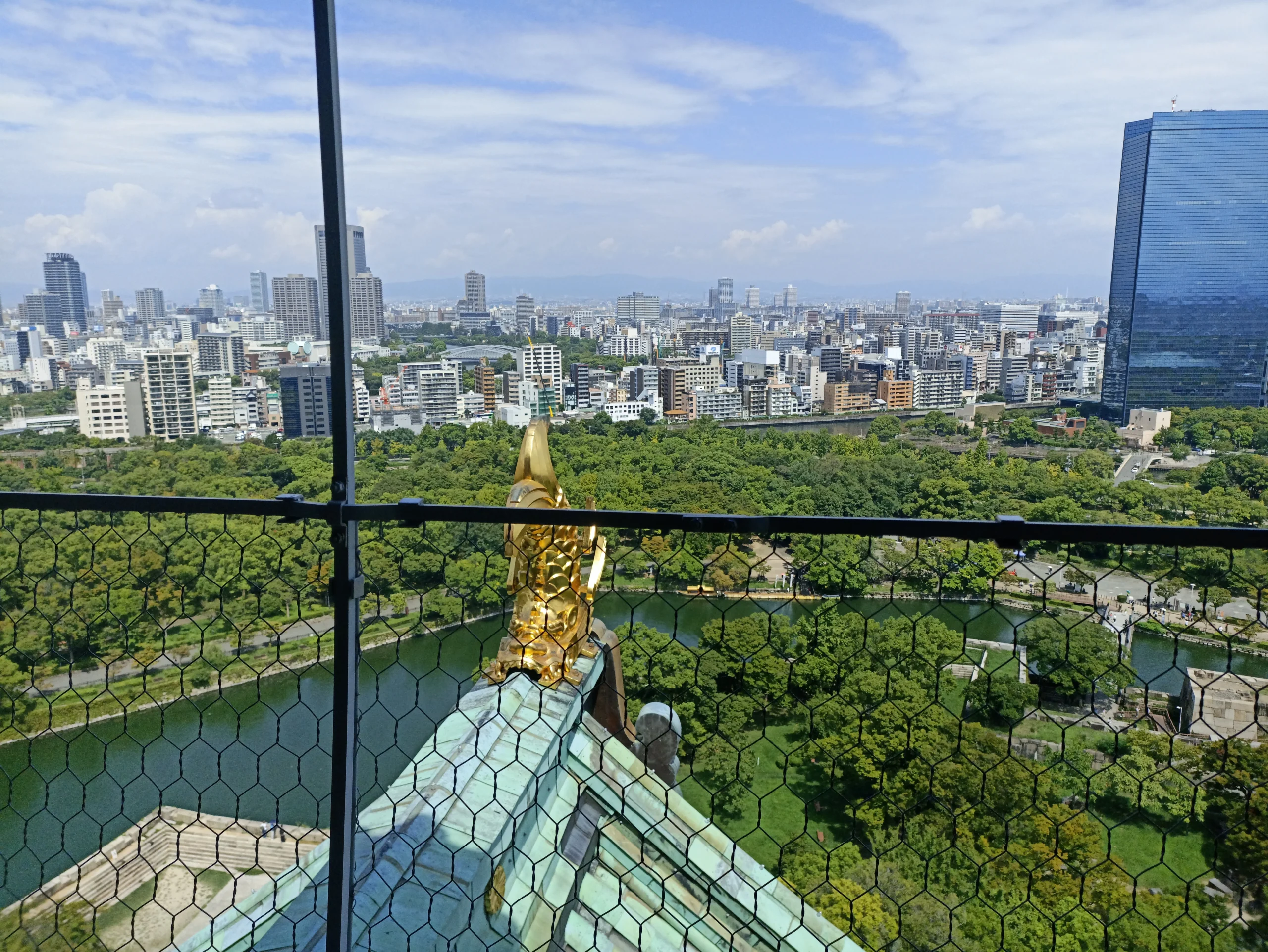
Panoramic view of Osaka. From Osaka Castle Museum.
Don't miss new posts
Join the email list and hear about new writing as it lands.
This was my first time ever going abroad, and the country I went to was Japan, a place we have almost nothing culturally in common with. That's why my first impressions were so strange. I noticed almost everything, because everything felt different and odd. Right off the bat, the passport control at the airport was strange. A barrage of instructions, various commands, illness warnings, and a long queue greeted us. According to my wife, things like this don't normally happen during passport control. These guys were being a bit much.
We landed at the airport in Osaka, got through the checks, and set off for the metro to reach our destination. Aside from the talking escalators, I'd say the metro was the first real shock we experienced there. Superior Japanese technology and their system had built an absolutely tangled web of a network, but we managed to get the hang of it somehow, and got off at the stop we meant to.
When we landed in Osaka, rain was there to greet us. "Could we be called comrades of the rain?"(inspired by İsmet Özel) No, we couldn't — because we realized, dragging our suitcases to the hotel soaked to the bone, that we'd arrived in a city bracing for a typhoon without raincoats, without umbrellas, and in canvas sneakers. We squelched into the hotel — which, as it happened, wouldn't let you in with a wet umbrella — shoes squeaking, water dripping from our chins, and settled into our room. That's how the Japan adventure began.
The next day we visited the places we'd already marked on the map: the Osaka Museum, Osaka Castle, Hozen-ji Temple, the covered bazaar known as Ichiba Market, the quirky district called America-mura, and Dotonbori, and that wrapped up the city for us. I won't be putting up a photo of every single place here. You can find far better shots than the ones I snapped "point-and-shoot" style with a quick Google search. Instead, let's keep going with the things that caught our attention.
Temple
We made our first temple visits in Osaka. We toured a handful of temples, some large, some small. Each temple has its own distinctive character, but they also share a great deal in common. In general, a temple visit begins with a ritual ablution. Then a coin is tossed into the box in front of the temple. This is followed by a bow, a clap, a prayer, and the act of worship is complete. None of this stirs any sense of "worship" in me. In my mind, worship is something that conjures up a longer, more dedicated stretch of time set apart for it. Of course, this may well just be a habit carried over from being Muslim.
At a small temple where we stopped to rest, though, things were a bit different. There was a moss-covered statue of the Buddha. Even though there was a place to perform ablution, we didn't see anyone actually doing it. A coin was dropped into the box. Incense was lit. It was stuck upright in a cauldron already full of candles set within the incense. Then people prayed in front of the statue and stuck their candle somewhere else. After that, the Buddha statue was doused with water. That was the reason for the moss.
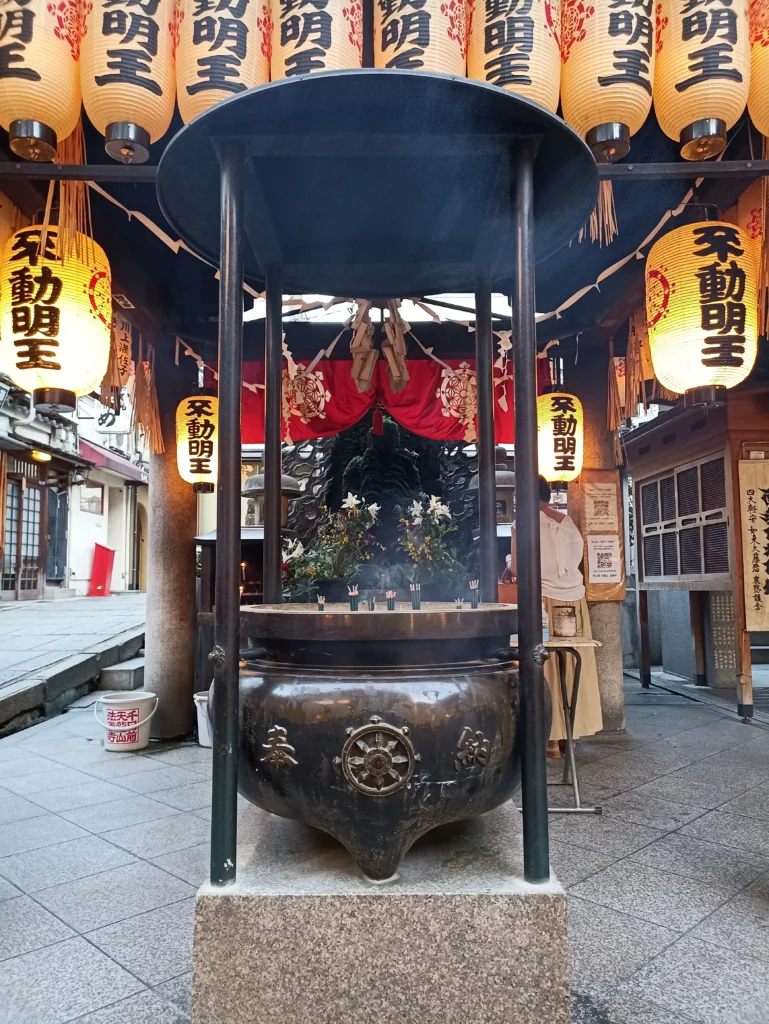 Moss-covered Buddha
There's no hand-clapping, bowing, or ablution in Buddhist ritual. We saw those in Shinto.
What we'd call worship, or prayer, at these temples takes very little time. It's also hard to tell that most temples are actually temples. To put it more precisely: you're walking down the street, the navigation app says you have ten meters left, and you can't see anything resembling a temple anywhere around you. You look left and right, take one more step, and — there it is, a temple, right inside. It's as if it's gotten lost somewhere within the city. If I compare it to one of our neighborhood mosques, a mosque announces itself with its minaret and so on. There's nothing like that here. Our mosques have a whole complex around them, an inner courtyard, an outer courtyard, various structures around the perimeter — at least in Ottoman architecture. So you feel it when you're approaching a mosque. Here there's an inner courtyard, fine, but you can't tell what it is just by looking from outside. There's an enormous dragon's mouth — I'd assumed something like that would be what greeted us from outside. Turns out it was inside, not outside. Outside, there's just a standard gateway.
There was one more thing about the temples that caught our attention. I think these folks keep alive the Anatolian custom of tying string to a tree, only here it takes the form of hanging little wooden plaques at the temple.
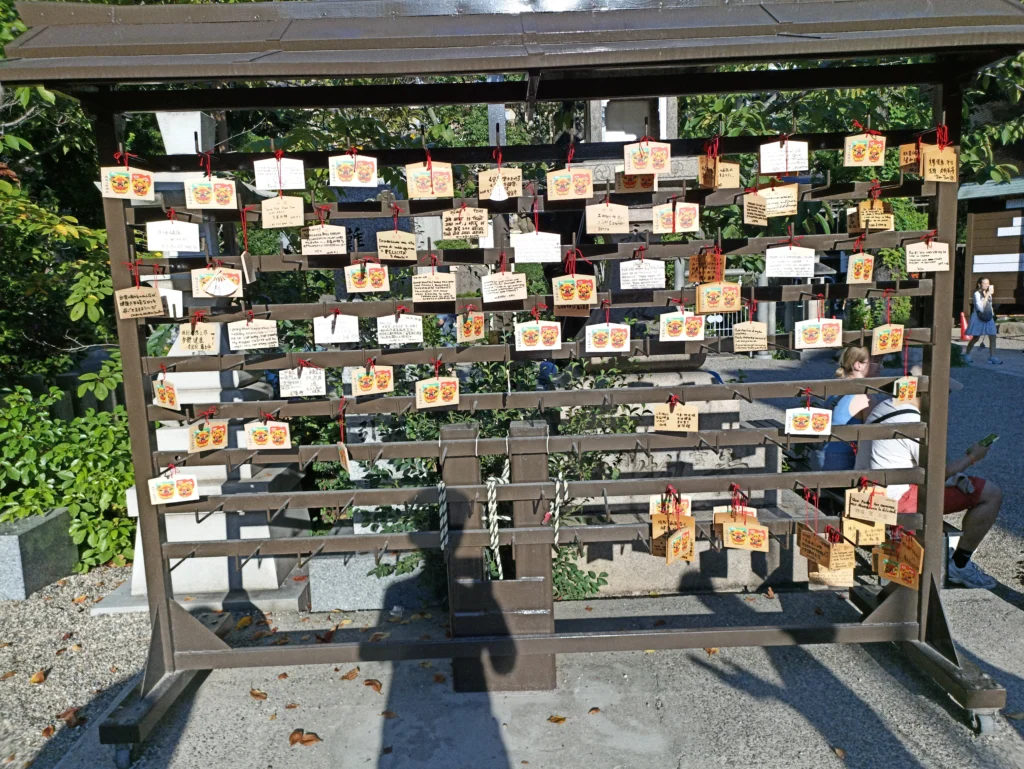 Wishes hung up.
As far as I recall, we could see this wish-board at every temple. People write their wishes on little wooden plaques bought for 50 to 100 yen and hang them on this board, hoping their voice will be heard by someone. When we first saw the board, we thought nothing of it, but a surprise was waiting for us just a little further on. Apparently, a sight was lying in wait just ahead that would leave us standing motionless for a good minute or so. News from the kami:
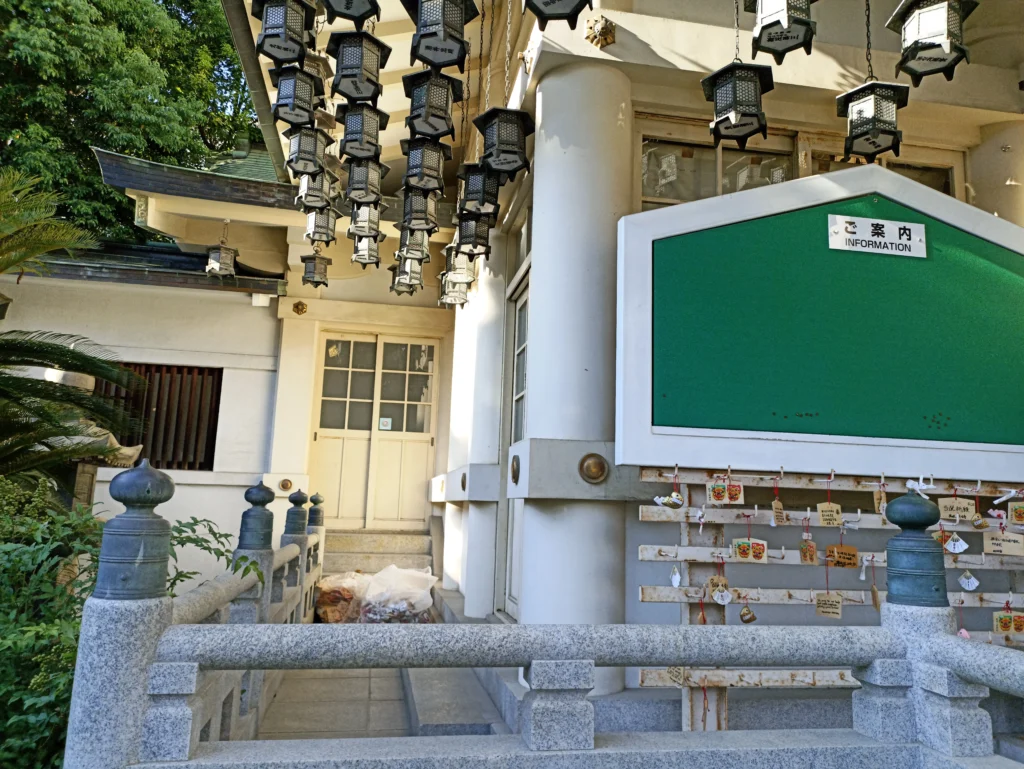 Wishes on the ground
You'll see a bag on the ground. Not quite clear, is it? Let's make it clearer:
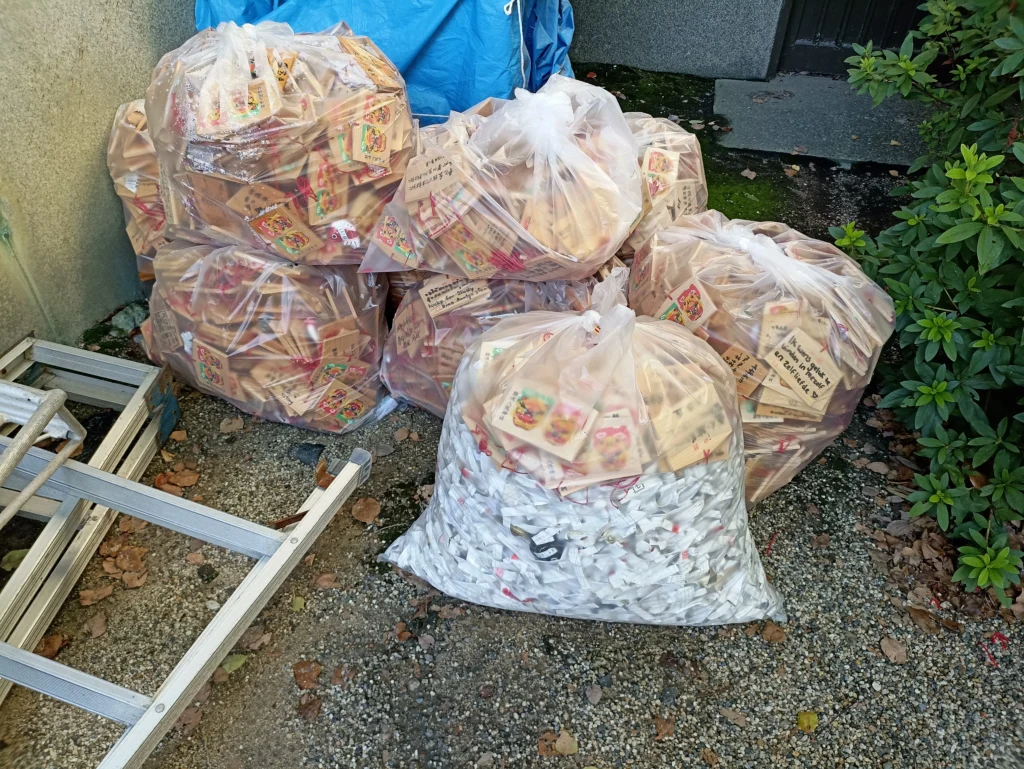 Wishes in the bag.
The wishes these Japanese men and women had sent off, perhaps with a thousand and one hopes, were waiting for them there — in garbage bags… It was a strange feeling, seeing this scene.
Al-Hajj 31: Inclining [only] to Allah, not associating [anything] with Him. And he who associates with Allah — it is as though he had fallen from the sky and had been snatched by birds, or the wind had carried him down into a remote place.
Ar-Ra'd 14: To Him [alone] is the supplication of truth. And those they call upon besides Him do not respond to them with a thing, except as one who stretches his hands toward water [from afar, calling it] to reach his mouth, but it will not reach it [thus]. And the supplication of the disbelievers is not but in error.
With these verses in mind, we continued on our way…
See you in the next piece, and the next city — that is, in Kyoto. Nelweda…
[1] https://www.youtube.com/playlist?list=PLZzV2gqYCPyuZIXhfFVUmHH-fbWn0Lpvz
Don't miss new posts
Join the email list and hear about new writing as it lands.
Japan Trip
- An Attempt at a Cultural Autopsy of Japan, or Travel Diary 1: Introduction and Osaka (you are here)
- An Attempt at a Cultural Autopsy of Japan, or Travel Diary 2: Kyoto
- A Cultural Autopsy of Japan, or Travel Diary 3: Tokyo and Closing
Comments (0)
Be the first to comment.