An Attempt at a Cultural Autopsy of Japan, or Travel Diary 2: Kyoto
In the previous piece, we talked about the story of our trip to Japan, about Japan itself, and about Osaka. Now it's Kyoto's turn. Let's begin.
KYOTO
After wrapping up our business in Osaka, we set off for Kyoto in the evening so we could start the next morning already there. Reaching Kyoto by the metro line wasn't difficult. We settled into our hotel, rested, and began touring the streets of Kyoto.
…
The Bookshop
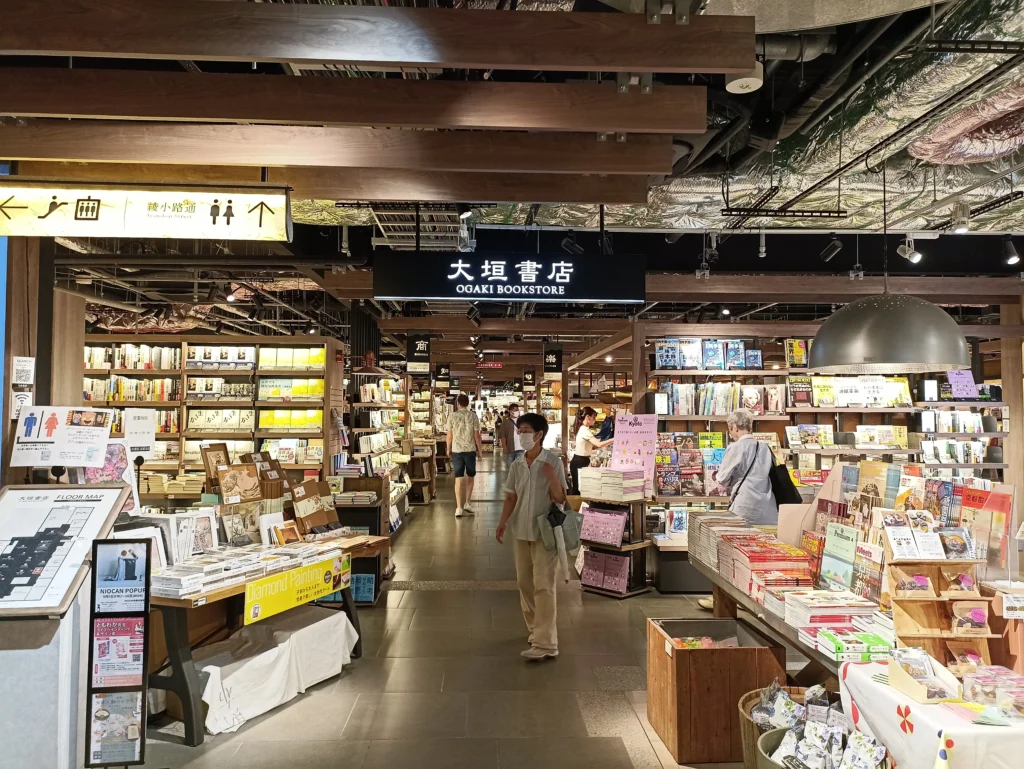
On the morning after the night we arrived in the city, as we set off again to tour the streets of Kyoto, we spotted a large book café right next to us and dove in. You can think of it as something like our own İstanbul Kitapçısı — only bigger. Here, the book section, the café-restaurant section, and the gift section were all larger than İstanbul Kitapçısı's.
The first thing that caught our attention in the bookshop was how the books were categorized. For instance, we couldn't find a "Religion – Belief" section anywhere. Back home, religion has its own dedicated section, and depending on the store, it's usually well stocked. Here there was a section called "Idea," but because of the difference in alphabet, we couldn't get a sense of what the books actually contained. Perhaps the religious books were there after all — and even that fact says something about how the Japanese perceive religion.
The children's books section, meanwhile, was labeled "Family." That caught my attention too.
Another thing that caught our attention was the Travel section. We have that section too, but ours is full of books about other countries. Here, though, the books were about Japan itself, and they were in English. Understandable enough — they're aimed at tourists, after all.
As for the books, we could say they were small in size but had a lot of pages. Their dimensions were a notch bigger than the pocket paperbacks put out by Can Publishing back home, and they ran to more than 200 pages, printed on very thin paper. The text runs top to bottom, and the books open from the right, like Arabic-script books. Prices: literary books, for instance, were around 600 yen, a little under 150 lira at today's exchange rate. The Travel books, though, were 2,000 yen — glossy, large-format, full-color pages, and in English, so presumably foreign-licensed titles. That felt reasonable once you compared it to the other books.
A bookshop in Kyoto. The place that left us illiterate in a single night.
But the thing that set us thinking most deeply in that bookshop was that, simply by coming to Japan, we had become illiterate overnight. Thousands of books stood before us, yet we understood not one of them, could scarcely even bring ourselves to touch them. We stood in a kind of awe and dread before thousands of lifetimes, millions of hours spent. We felt a profound helplessness in the face of pages written in a wholly different alphabet and language. Images of the burning libraries of Alexandria and Baghdad flickered through my mind, alongside libraries that could never be reached or exhausted even on the internet, that would take hundreds of thousands of lifetimes to consume — and with these strange feelings, we left the bookshop behind and carried on striding through Kyoto.
Nishiki Market
Our next stop after the bookshop was Nishiki Market — this city's version of our Grand Bazaar. Japanese shopkeepers shouting to draw in customers, curious tourists, locals who clearly knew exactly what to buy and where, an ice-cream vendor set up right across from a grilled-fish stall… It was a place we found familiar, and yet couldn't help finding strange all the same. Everything was the same, yet everything was different.
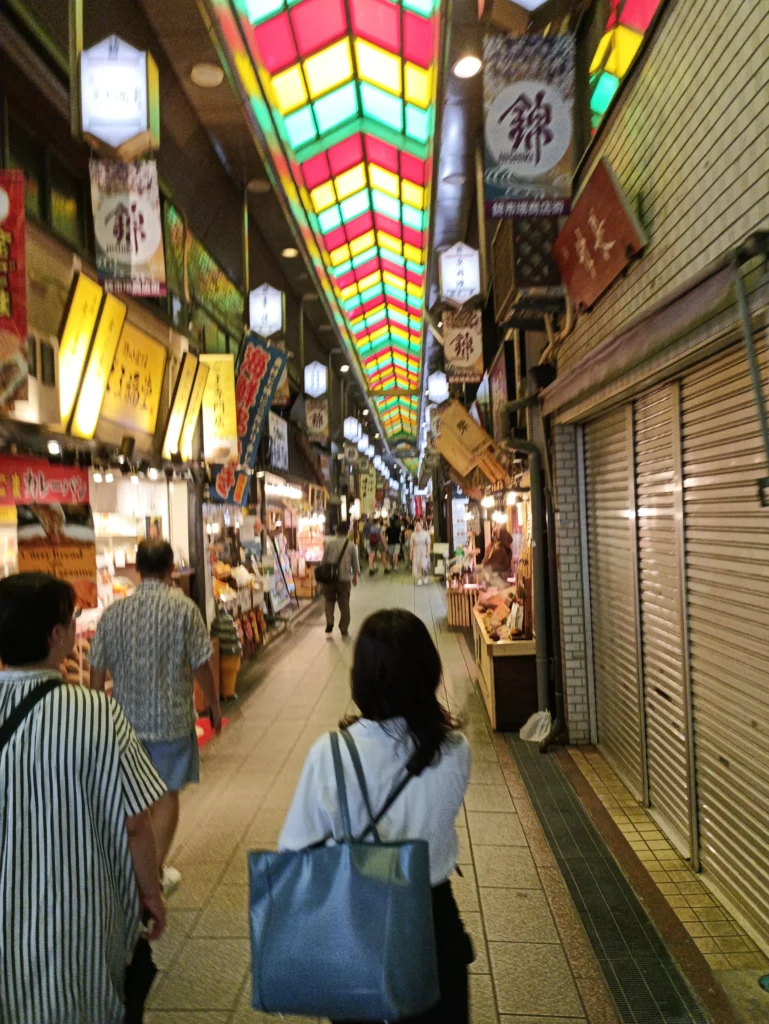 Nishiki Market. One photo we took "point-and-shoot" style.
After the covered bazaar, we came across a Zara store and thought it would make for a nice opportunity to do some sociological observation, so we dove in. Naturally, something related to clothing in Japan was waiting for us here too. From what we could tell, people in Japan dress quite comfortably. They can pull off combinations that would look mismatched back in Turkey. Aside from that, what caught our attention regarding women's clothing was that we never once came across a woman in revealing clothes. If anything, far from revealing, people were practically wearing something like a full-body cloak. We even thought that Sharia had arrived here in its legal form, missing only its metaphysical dimension. Even when women wore short-sleeved clothes, they'd cover their arms afterward with separate sleeves, and layer loose garments on top. Skirts, too, were quite common. Even more interesting was that they wore face masks covering more than a veil would. We put this down to a desire for sun protection — which is also, presumably, why they never let go of their umbrellas.
First Contact
After leaving Zara, our next stop was Chion-in, a Buddhist temple. Though we'd already seen plenty of temples by then, this one left a different kind of impression on us, because it's still an active temple. We could actually go inside, and we even happened upon a ceremony while we were there. As for the temple itself, we could describe it as quite splendid: somewhat dark, richly ornamented, with several statues of the Buddha. All the splendor in the temple is concentrated at ground level. With us, there's no splendor to speak of in the first place, but the most ornate part, if any, tends to be the dome. And on the dome you'll usually find verse 35 of Surah An-Nur, which contains the phrase "Allah is the Light of the heavens and the earth." Perhaps this is a somewhat progressivist reading, but we might make sense of the contrast this way: God moving from the earth up into the sky. In animist-pagan belief, God is within the universe — is, in fact, the universe itself. In Hinduism, the gods represented in physical form are the earthly manifestations of God. In other words, God is really down here, on earth. In our tradition, though, even brushing up against such a belief counts as shirk. God is utterly unlike His creation. He is the Light of the heavens and the earth, yet nothing resembles Him in any way. Muslims, therefore, have no need of a representation of God in order to communicate with Him. These people, on the other hand, communicate with God through representation, and in doing so bring Him down to earth. That, presumably, is why their temples are so ornate, while our mosques are quite plain.
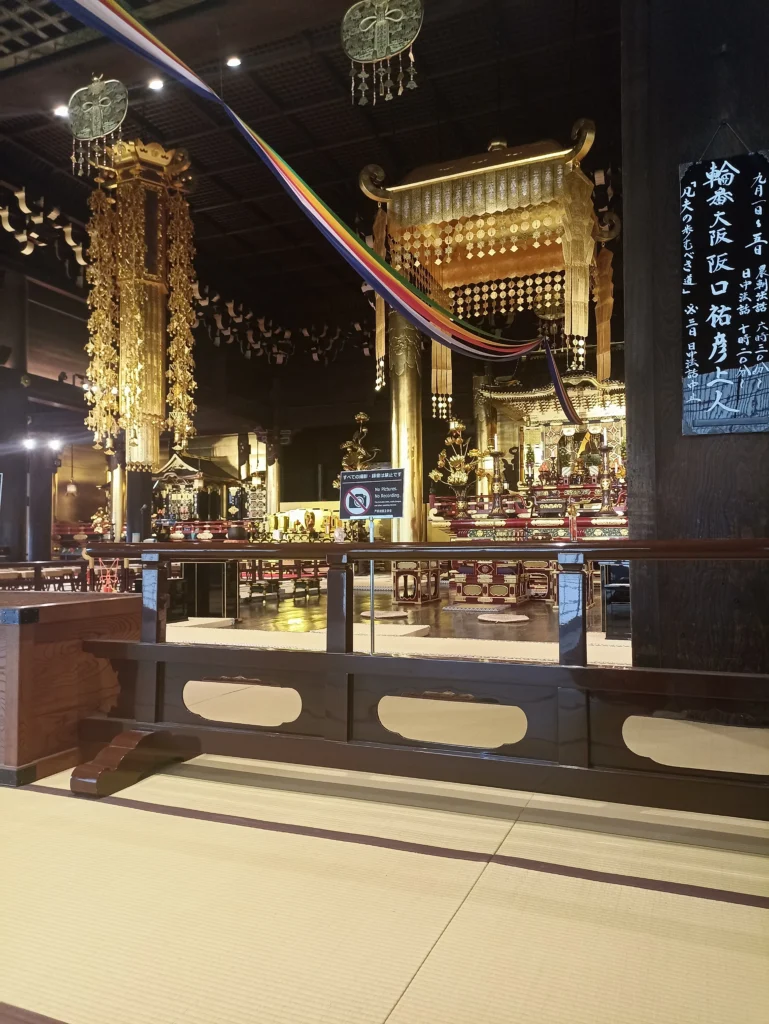 Chion-in Buddhist Temple. Photography was forbidden. This, I suppose, must be the Buddha's rope.
Anyway, there were Buddhists who came to the temple to pray. Some were meditating. Among those meditating, a young European caught my attention. One of my biggest motivations for coming to Japan had been to talk with people of different faiths, and I suppose I was finally about to get the chance. I'd asked a few questions before to temple staff or to a few people at prayer, but I generally didn't get satisfying answers. Those people, I gathered, were fairly plain, unreflective believers (we later learned their salaries were quite good too). This young European, though, seemed like someone with real knowledge. Anyway, I positioned myself and waited for him to finish his meditation, and as he was leaving the temple, I caught up with him by shouting "WAAAAIT" and asked him a few questions.
We told him we were two young Muslims from Turkey. We'd toured quite a lot of temples. It had been a rather different experience for us, given the entirely different culture, entirely different religion, entirely different conception of God. We said, you don't look like you're from around here either — what wind blew you into this mountaintop temple?
He was an understanding young Australian in his early twenties, willing to chat, named Jack. From what he told me, he'd gone to a Catholic school for a while. He'd come to reject the church's dogmatic teachings and started seeing Jesus as more of a teacher than a god. He'd since also developed a certain resistance to Christians, because he found that Christians spent more time arguing over the correctness of the doctrine than engaging with the doctrine itself. As he put it, "you guys are missing the whole point," and he'd found himself drawn toward Buddhism, even if he didn't agree with the whole of it. After this short exchange, I asked him whether he'd ever heard of Islamic Sufism. He hadn't heard of it at all. He'd probably never looked into Islam either. Who knows, maybe thanks to this little hook of a question, years down the line he'll look into it, become a Muslim, and write about it in a blog post of his own. Maybe he'll say: "In Japan, at some temple or other, I had a brief chat with Batuhan and his shy friend. That was the first time I'd ever heard the phrase Islamic Sufism. My research eventually led me to become a Muslim. Who knows where Batuhan is now? I hope you're doing well, Batuhan."
Don't miss new posts
Join the email list and hear about new writing as it lands.
Wife: you daydream way too much, Batuhan
Batu: "way too much," she says. I'm going to mention Jack in a blog post. And ten years from now, Jack's going to mention me in a blog post of his own. We'll never see each other again, never hear from each other again. We'll have absolutely no way of reaching one another. It's very strange. Anyway, maybe we'll meet in paradise. See you around, Jack.
Anyway, enough joking around. There was something that pained us as we toured the temples. The Buddha was, after all, a brother of ours who gave up a life of wealth and chose first an ascetic path, then a life of pious renunciation. Over time he spread his teaching across all of India, and eventually it crossed India's borders and made its way all the way to Anatolia. But as time went on, the followers of that ascetic mystic went and, of all things, cast golden statues of the man. If the Buddha saw the state of things now, he'd probably say, "is this really what was coming to us," and go commit harakiri on the spot.
A Few Observations
Another thing that caught our attention about the Japanese is how beautifully they've managed to fit their old traditions to the needs of the present day. How so? Take, for instance, when they want to put up something like a fence between two benches. They'll build that fence out of bamboo, while the bench itself counts as a fairly modern design. The railing set behind it is quite modern cast-iron material, yet the bamboo fence placed right there doesn't look remotely eclectic or out of place. These people have managed to produce a genuine synthesis. Out of the clash between tradition and modernity, they've managed to give birth to a new culture altogether. We, on the other hand, got caught somewhere in between in that same clash, ending up neither fully one thing nor the other. The old saying — silk brocade on top, tin pot underneath — hasn't lost its truth. Writers like Tanpınar and Sabahattin Ali wrote beautifully about this very clash in their time. Anyone interested can look into their work.
***
We also visited a castle in Kyoto. It was a castle that could be called minimalist, with the kind of paper sliding doors you see in Japanese films. A well-fortified castle with two nested courtyards, between which streams stocked with crocodiles had been laid out. It reminds you of our own Topkapı Palace — in terms of scale, and in the way it's been turned into a museum. A few delicate, enormous buildings. We wondered what kind of person would grow up in a house like that. Doors made of paper, floorboards singing like birds under your feet, shadows cast against the walls… and what, on the other hand, does someone raised in Dolmabahçe or Topkapı turn out like? The effect of a place on a person — or a person on a place — gives you plenty to think about.
On our second day in Kyoto we went to the famous Fushimi Inari shrine, and passed through ten thousand torii gates, moving up a rank with each one, hoping in the end to reach Buddha. We got to the shrine by metro. The metro station itself had been designed to match the look of the shrine. We liked that.
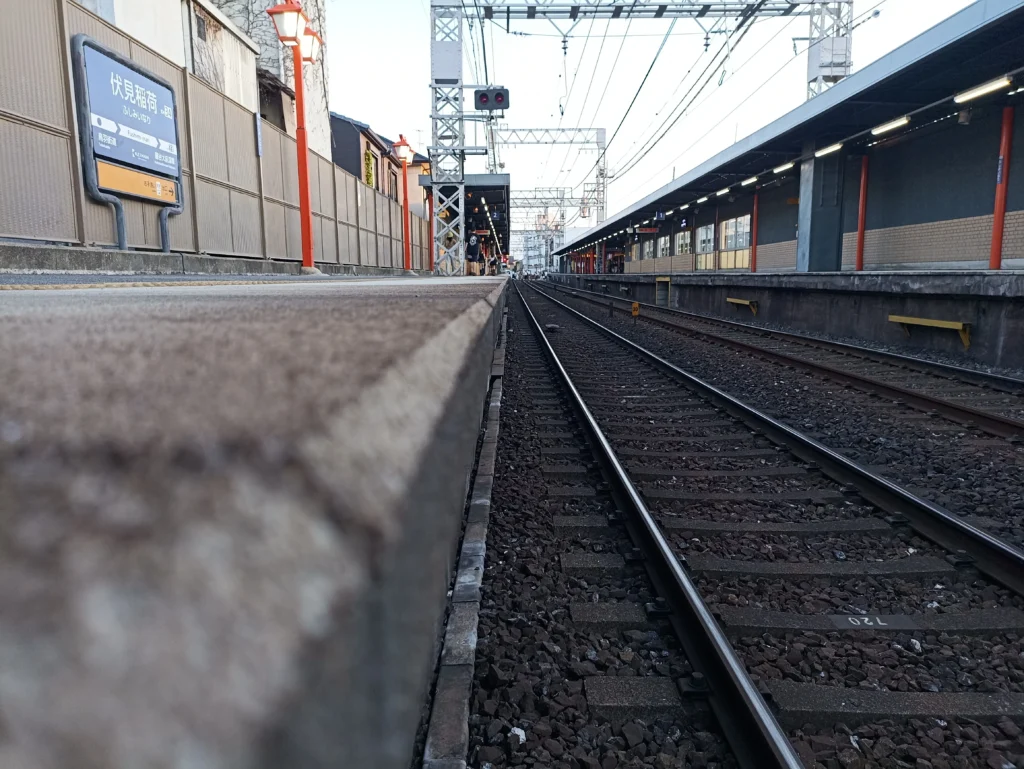 Fushimi Inari metro station, and the poles we likened to torii gates.
The shrine sits atop a mountain. Or rather, all over a mountain. They've placed smaller shrines at regular intervals up the slope. Between the shrines are these orange gates, or passageways. It was a beautiful, exhausting experience. We rested here and there and took in the view of Kyoto, but, probably because of the season, it stayed quite hot even though it was evening. I have no idea how many liters we sweated out by the time we got to the top. Take it from us: if you're going to pass through the torii gates to purify yourself, bring water, and don't bring any trash. Otherwise you'll end up thirsty, and you'll be carrying that piece of trash around in your hand for three hours straight, because there are no bins. And water up there costs twice what it does in the city :)
Anyway, we climbed and climbed, and finally reached the place they call the "Top," only to find — there's nothing there, brother. Was all this trouble that had latched onto me for nothing? Why did I even bother climbing up here? They'd just put the exact same shrine here as the one before. Anyway, if you ever find yourself there, you don't actually need to climb to the top of the mountain. Nothing is waiting for you up there. Whatever you're looking for, it's inside you.
As we climbed up to the shrine, I had the chance to observe the behavior of certain members of the human species. Then I found myself doing the same and got to thinking. As members of this species climbed toward a shrine — when they were meant to be passing through the torii gates and being initiated — they had cameras in hand instead, snapping photos of Kyoto from whatever convenient spots the mountain offered. I wondered: what would the Buddha have done if he'd come up here? Would he have followed the sign that said "Good View" and gone off to look at the city, or would he have gone through the gates and looked for the "view" there instead? It struck me as strange, honestly. You climb up to a shrine, brother, and end up taking photos because you find the view of the city pretty. This, really, is a matter of how religion itself gets received. Religion, too, is bound by the perception of the people of its own time.
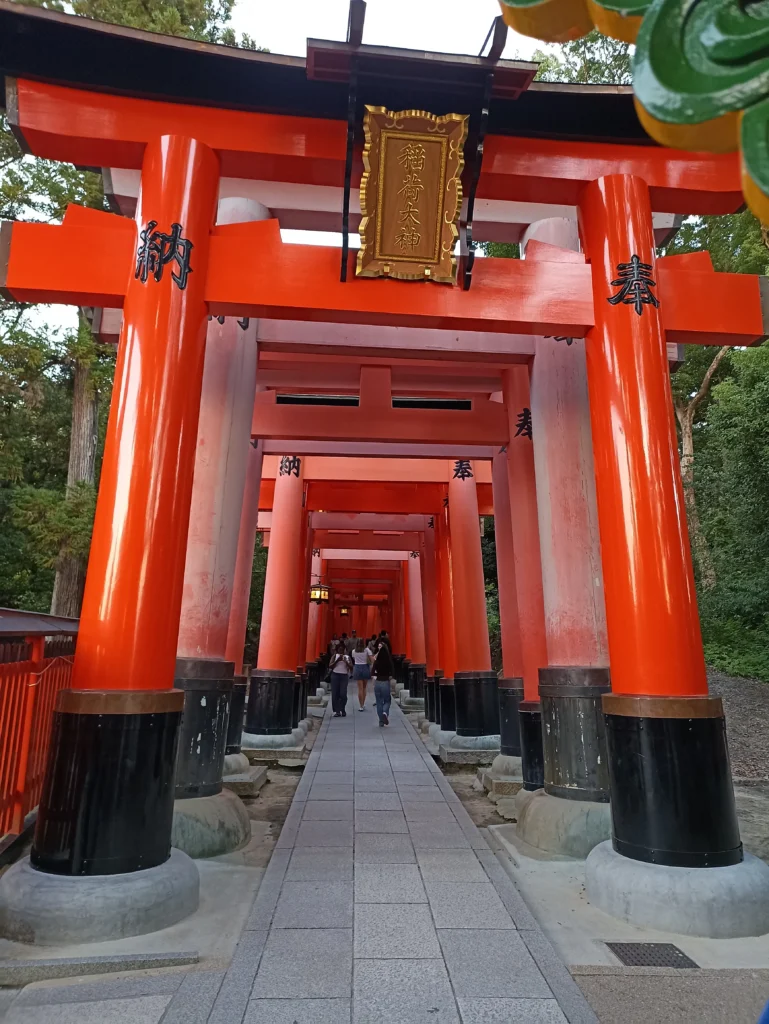 The first of the torii gates, after the ten-thousandth of which we decided we'd earned ourselves the title of Ninja…
The End
You've just read an abbreviated account of our Kyoto adventure. Our next stop after this was Tokyo. See you in the next piece.
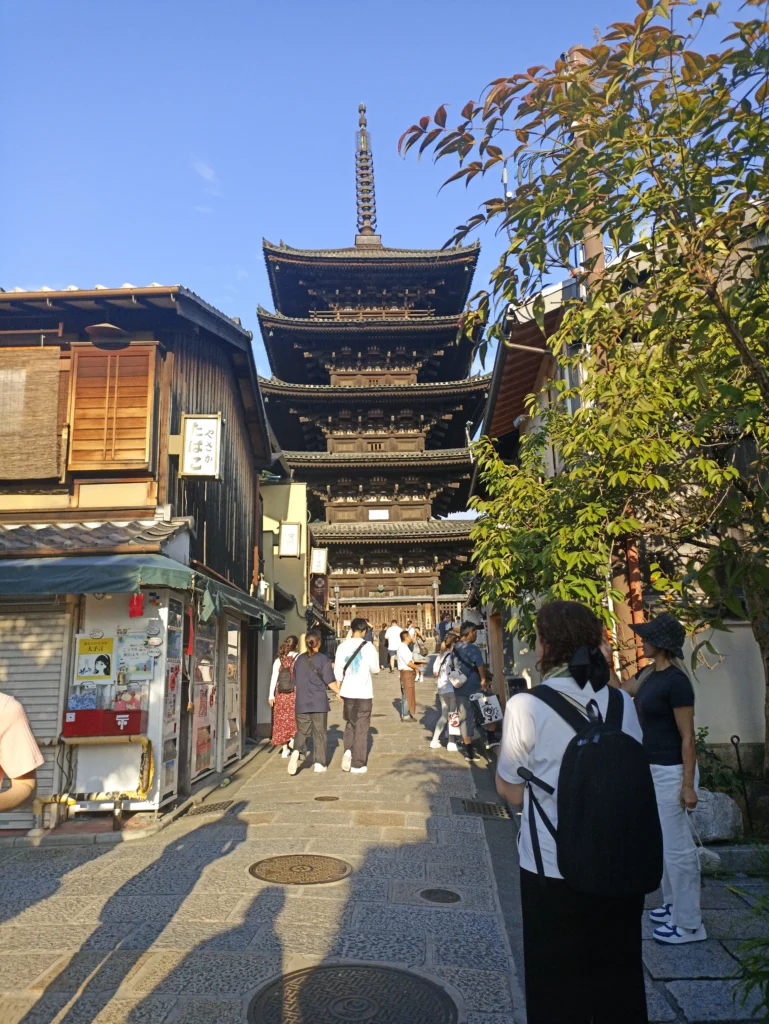 Kyoto's Galata Tower
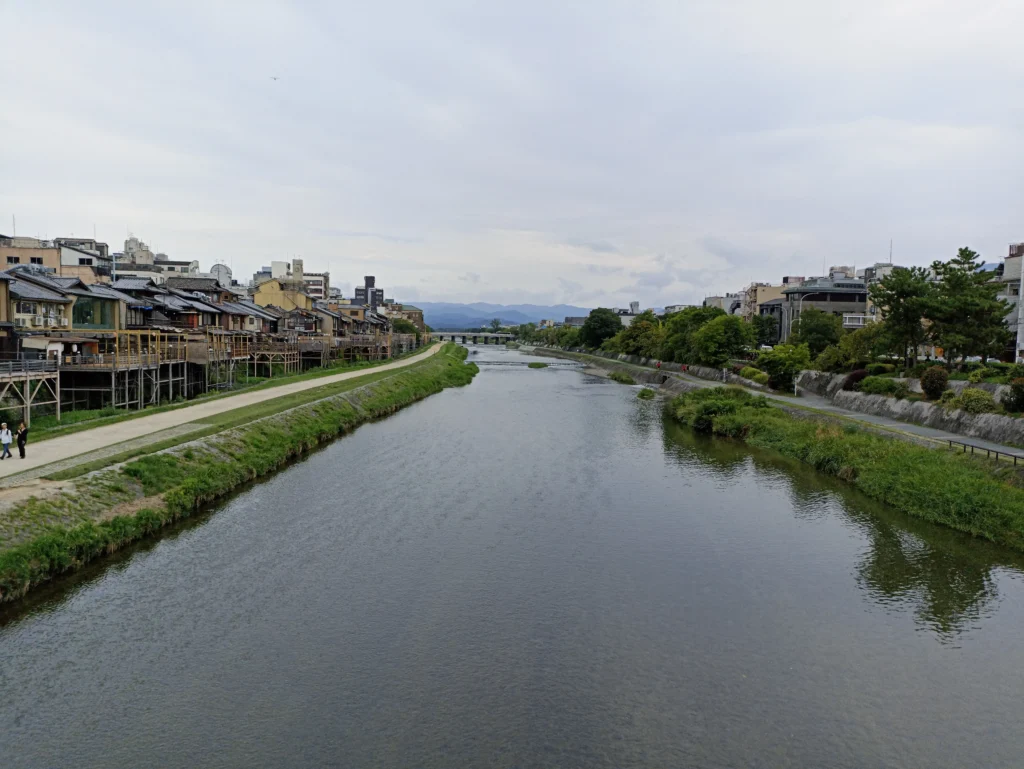 Kyoto's Balat
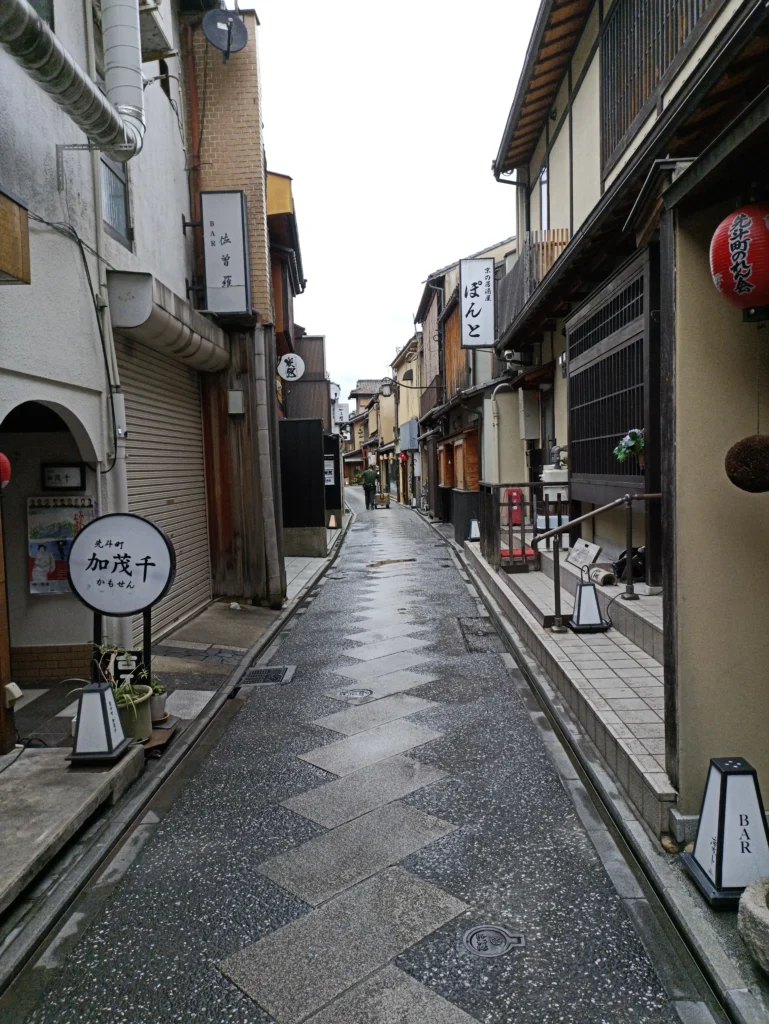 Kyoto's Tarlabaşı
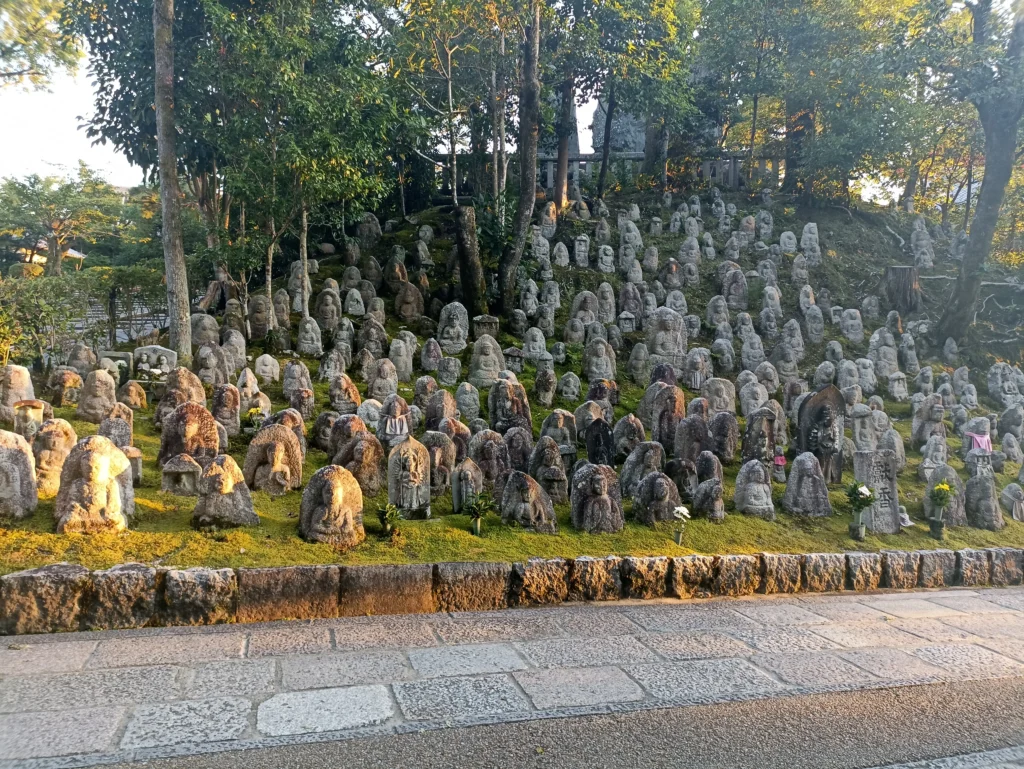 Kyoto's balbals
Don't miss new posts
Join the email list and hear about new writing as it lands.
Japan Trip
- An Attempt at a Cultural Autopsy of Japan, or Travel Diary 1: Introduction and Osaka
- An Attempt at a Cultural Autopsy of Japan, or Travel Diary 2: Kyoto (you are here)
- A Cultural Autopsy of Japan, or Travel Diary 3: Tokyo and Closing
Comments (0)
Be the first to comment.