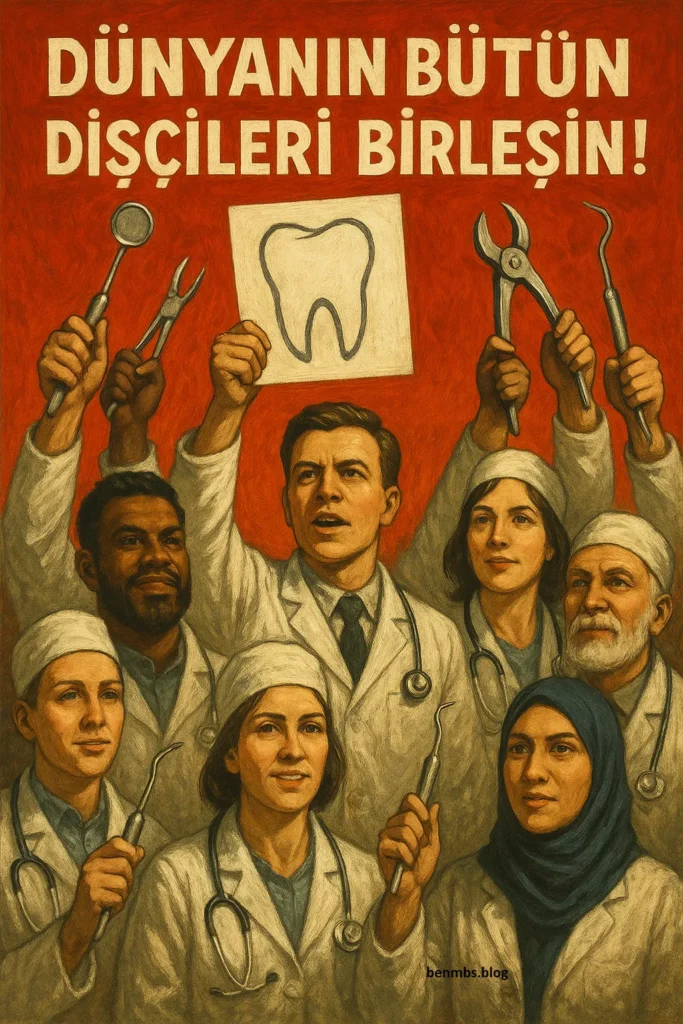
Dentists of the World, Unite!
The other day, while reflecting on the sorry fate of dentists, I came across a piece by Dr. Davut Torlak of the Social Dentists' Collective at https://toplumcudishekimleri.com/ucretli-dis-hekimlerine-kalan-davut-torlak/, and set about reading it. Finding many points in it worthy of attention and critique, and wanting to think them through a little more deeply, I decided to put together an assessment and a critique of my own. In this piece I intend, first, to highlight some of Davut Bey's emphases, and second, to deepen and critique others. Let me say up front that I have written this from a reformist standpoint aimed at our acute problems, without denying the need for structural change. My reason for writing it is the hope of contributing to an atmosphere of discussion — and to the agenda itself — around the problems we experience as dentists. I hope this effort makes some modest contribution, intellectual and practical, toward solving the problems we live with.
First I will remind readers of the broad outlines of Torlak's text, then voice a number of criticisms of it, and finally set out, from my own vantage point, the problems the profession is living through, along with solutions of my own. In the first two sections I tried to write in a more detached, academic tone; in the last section, though, I wanted to write as it came to me. Perhaps it would have been more proper to keep the detached tone throughout, but when speaking about problems we experience personally, and possible personal solutions, I thought that speaking plainly — speaking from the inside — might serve better than keeping one's distance. The judgment is the reader's to make.
Examining the Piece
In his piece titled "What's Left for Salaried Dentists", Torlak focuses specifically on the "salaried employee" dimension of dentistry, addressing at length the inequalities within the profession, its structural dependencies, and the insecurity and loss of rights the system produces. Among the things that stand out is the emphasis that many of these problems stem from structural causes, and that the solutions on offer are, at bottom, far from being functional solutions. Another notable point in the piece is its demonstration of how independent private practice constitutes a source of power and a threat to monopolies and bosses.
According to Torlak, the problems salaried dentists face have undergone extensive structural change because of "the neoliberal health policies the AKP implemented under the name of the 'Health Transformation Program,' in order to clear the way for marketization in health," and conditions have shifted in favor of employers. In Torlak's view, the core problem salaried dentists face is "not being in a position to decide on their own working conditions, and having lost the capacity to intervene in them." This condition is both cause and effect of many other problems. We can summarize the piece's central claims and proposals in a few points:
- The professional chambers refer to salaried dentists as "the young ones" and fail to produce genuine solutions to their problems.
- The tradesman-dentist model created by the system's "be your own boss" slogan is one in which dentists effectively sell their labor to bosses — a system that fills the bosses' pockets while dentists are stripped of their social rights. In this system, an employee's social entitlements — insurance premiums, taxes, severance pay — have been dumped onto the employee's own shoulders.
- Those who propose, as a solution, that dentists simply open their own practices are out of touch with reality. Not everyone can open a clinic. And even if they could, the existing system of exploitation would not come to an end, given the structural problems underlying it.
- A cooperative system might be considered as a solution, but this too cannot permanently resolve the existing problem. At the root of these problems lies the fact that the doctor–patient relationship has been replaced by a tradesman–customer relationship. The lasting solution is the expansion of public health services.
In his piece, Torlak offers his views and criticisms on each of these points. If we were to take up all of these views and criticisms here, we would end up reproducing the entire blog post. So let us cut the background section short here and try to underline a few points.
Critique of the Piece
I want to state up front that I generally agree with the piece. It must be granted that most of the problems we experience have structural roots. The examples raised in the piece — the tradesman model, working hours, the loss of rights — are, at bottom, a visible face, a consequence, of structural problems. The final solution, too, must be structural. For now, though, let us proceed through the examples.
It is impossible not to agree with our colleague on points such as: the tradesman model being a system of exploitation, working hours being inhumane, the chambers' failure to produce genuine solutions, the fact that not everyone can open their own practice, and the fact that part of the problem lies in the changed doctor–patient relationship. It is a system in which the boss dumps his own tax and premium burdens onto the employee, takes on no responsibility whatsoever, strips the employee of severance rights besides, and then tries to put makeup on the many needlessly created problems in the system with fancy phrases like "be your own boss." There is no defending this.
Also, as Torlak himself states, in a scenario where everyone opened their own clinic, it would not be possible for monopolies and bosses to persist, because it is employees who sustain the system's continuation. But we need to make a distinction here. The fact that employees sustain the system does not mean they are its efficient cause. Here, salaried dentists are, at most, a passive cause. The subject that secures the system's continuity and persistence is, first, the structural problems themselves, and then the bosses — these are the efficient cause.
While there are many places in the piece where I agree with our colleague, there are also some where I cannot.
In some sections, the transitions between analyses are here and there filled in with assumptions, and many of these assumptions, at points, go beyond being mere assumptions and take on the character of claims to certainty. Of course, offering a final solution on such a matter is difficult, perhaps impossible, but the piece, rather than offering solutions to the problems it names, largely stays within the bounds of a critique of the system. Let us open up these points and try to continue from where our colleague left off. What follows will take certain points in Torlak's piece as its basis, but will not stop there, and will try to broaden the matter from its own vantage point.
According to Torlak, what might happen if independent practice became widespread can be roughly schematized as follows:
Salaried dentists and public-sector dentists open their own practices => the monopolistic system collapses => prices fall in the free market => because profitability falls, dentists become unemployed => monopolies form again
Although this scenario aims to carry the possible situation to its logical limits, to my mind it does not match the practice we actually observe. The analysis rests on a few critical assumptions:
- That every dentist wants to open a clinic,
- That every dentist can open a clinic, and
- That the free market always works against the seller.
In practice, however, we see that many dentists, even when they have sufficient financial means, choose not to open their own practice, either because they don't want to take on commercial risk or because they lack management skills. Moreover, the existing system — not only in dentistry but across the entire economy — already operates on free-market dynamics; prices are shaped by competition, and various businesses catering to different income groups manage to persist. Yes, it's possible for some businesses to close, but here we arrive at another assumption: that the polyclinics where the now-unemployed dentists would go to work will regain their former strength. While the existence of such polyclinics seems inevitable in this scenario, their existing does not, to my mind, mean that things would return to where they started.
Another idea I noticed in the piece, one that's probably a rhetorical flourish but that I can't pass over without comment, is the notion that our structural problems remain unsolved in order to protect the profitability of monopolies. As I said, probably rhetorical — but I still want to dwell on it.
Yes, as our colleague also states, the condition for monopolies to exist is that public health services be kept limited. That is, at the root of most of our present problems lies the state's failure to provide public health services as it should. But rather than phrasing this as "it happens this way so that monopolies can preserve their existence," I would prefer to put it as: "the state offloads its own service obligations onto the backs of its citizens in order to reduce its fiscal burden." Yes, as it appears, the state is behind the emergence of many "sectors," dentistry included. Rather than employing more doctors and bearing the expense, the state leaves its citizens no choice but private hospitals; that same state, unwilling to allocate resources to tasks like improving the physical condition of schools, raising teacher competency, or making the curriculum of good quality, forces citizens and their children into private schools; and that same state, unable, say, to secure the safety of the streets, condemns its citizens to gated communities with private security. The state's failure to fulfill its duties gives rise to many "sectors" and to the formation of monopolies, but here we must be careful not to confuse cause and effect.
I am not well versed in the details of the cooperative model mentioned in the piece. Could the benefits expected from a cooperative model not also be achieved through corporations, given a well-drafted contract? Yes, cooperatives and corporations diverge in terms of founding purpose, but as I've said, is it not possible to arrive at similar outcomes through incorporation — not at the starting point, perhaps, but in the end result? For that reason I'll pass over this part. This distinction could be the subject of another piece. Let it rest for now.
Let us turn now to the problems as I see them, and to my proposed solutions.
My Thoughts on the Problems and My Proposed Solutions
First I want to state that I have no intention of denying the existence of structural problems. I already granted this at the start of the piece. Many of our problems do appear to be structural. Torlak, too, is fundamentally trying to offer a perspective for resolving these structural problems at the root. But here I will approach the matter pragmatically, by asking: "how might these things be resolved without a workers' revolution?" Yes, I too want every segment of the public to have access to healthcare, and indeed to not need the private sector for it. But saying that the solution is possible only through structural, root-level change, through the expansion of public health services, feels to me like laying the blame on the system while ignoring individual responsibilities. Yes, I grant there is a risk here of loading the system's problems onto individuals and ignoring the structural ones. Still, I want to run that risk and try to make the assessment anyway.
I want to think through and question how much of what dentists are currently going through could actually be resolved without systemic transformation. Must it necessarily mean opening an institute and a cooperative in every village, having the entire population treated free of charge in public hospitals or cooperatives, and having dentists work under the state's umbrella? That may be the ideal order, or something like it, for many people, but as I said, let me ask again: is this the only way to solve, or at least to make bearable, the problems we're living with right now? Yes, I'm aware that the lasting solution to these problems lies in systemic, not individual, transformation. Yes, the changed doctor–patient relationship, the turning of health into a kind of service sector, and so on, lie at the root of the problem — but we cannot change these things overnight, and besides, the problem isn't confined to our country alone. There's a cultural shift happening worldwide. Given all this, is there truly no way to make our present a little better? We surely want the welfare of the masses, but does that stop us from taking small steps for our own modest lives? By asking these questions, I've come to think that some part of the problems we face can be addressed through micro-solutions. For this reason, at the cost of breaking from the framing so far, I'm opening a new page and beginning to think, using the structural problems as a stepping stone.
Many of the problems we see in the market are, in fact, not unique to dentists but common to nearly every sector. Because in this country we are a people who still have to fight employers to obtain the rights the law has already granted us. What do I mean by that? If we didn't still have to fight for our legally established rights, would there be any need for a job posting to declare "minimum wage + social security + meals"? Come on, brother — the minimum salary you're going to pay is, by its very name, the minimum wage. What you mean by "social security" is simply the premium you, as the employer, are legally required to pay in any case; and "meals" is likewise something that's already supposed to be covered. So what exactly have you announced here?
We are a people who still have to talk our bosses into granting us the rights the law already gives us. Because to use your annual leave, you first have to keep your boss's exalted mood intact, and second, safeguard the business's profitability. Today, when a dentist working at any given clinic says, "Boss, I'd like to take leave next week," here is the scene that unfolds: first, silence. The boss pretends to be mulling something over. Then comes an "hmm." And he asks: "Everything all right, doctor?" This is where the persuasion session begins. You have to say something that won't irritate the boss, in a way that won't irritate him. "Well, boss, it's just that..." Then that mysterious sound again: "hmm." The eyebrows tense. The eyes narrow. And that wisdom-laden question drops from the boss's lips into the void: "How on earth are we supposed to manage that?" You fall silent. The boss continues: "Dr. So-and-so also said he'd be leaving, but, hmmm... so when exactly are you thinking of going? Hmmmm... how are the patients doing? Hmmm... all right, doctor... let's try to work something out." You remain on edge until the day you're due to leave, because there could be an update at any moment. Because, after all, it "will be looked into." This is the good-case scenario. In most cases, either your leave gets trimmed down, or your holiday is pushed off to some unknown date.
Don't miss new posts
Join the email list and hear about new writing as it lands.
In any case, let us name the first of our problems, then: the corner-shop order
Yes, dentists operate under a system that is more blue-collar than white-collar. As far as I can tell, most clinics are businesses run at the consistency of a corner grocer's — let's be kind and call it a "market." Being small businesses, professionalism is a distant hope. We work at a level slightly above the neighborhood grocer, trying to keep the boss in a good mood. As I said in the preceding lines, the reason for this problem is the fact that we have to fight to make use of the rights the law has already granted us. And the terrain of this struggle is not the law but personal relationships. The boss forges a kind of debt-of-gratitude bond with his employee, and makes the employee who claims his rights feel indebted to him — or at least, kept on edge.
The second problem is, in fact, a continuation of this: working as if there were no holidays
I wonder how many dentists actually take the day off on May 19th, October 29th, July 15th, May 1st, or the eves of religious holidays. As far as I know, there is exactly one polyclinic that declares itself closed on official holidays. Let's say, generously, that you know of nine more. Is there a total of ten clinics in this whole vast country that give their staff the day off on these dates? You won't find them. Why? Because we are corner grocers. We are the subjects of a government that runs the country like a company, running our own clinics like corner shops in turn. My dear fellow dentists, and our precious capital-holders, let me ask you: why on earth are you running a business that would go bankrupt if it stayed closed for ten extra days a year? Perhaps if I phrase the question that way, it'll land better.
From here we move to the third problem: working as if there were no tomorrow
At many of the clinics I've applied to, seen, or heard about, the resident dentists work six days a week. In the interview, the sentence my counterpart — usually the boss — flings in my face, as if he's found some clever gotcha, is "Doctor, we work six days here," while the sentence I have to swallow is: "Well, aren't you the enemies of labor, feasting on this arrangement." This is something I genuinely fail to understand. Friend, keep your clinic open 24/7 if you like — I see no problem with that at all. But what is the logic in making dentists work six days a week? Nearly all dentists already work on a commission basis — meaning they earn their own salary. In that case, I genuinely fail to see what the boss loses by employing four dentists instead of three. Maybe hiring one extra dentist has costs, like taxes, but come on, friends, don't feed me that. Which clinic's tax declaration even matches reality? And couldn't the extra tax you'd pay be offset by the dentist's boosted motivation to work? Besides, clinics that operate on a fee-for-service basis don't even have this problem. Fine, maybe in Anatolia it's hard to find dentists, maybe the arithmetic doesn't allow for a four- or five-day week — but brother, is there no dentist to be found in Istanbul or Ankara either? We have quite literally set up an absurd system for ourselves and kept spinning the same broken record for years. Why on earth would an entire sector do this to itself?
I have no objection to weekend or evening shifts; for some dentists these hours may even be preferable, and the accessibility of healthcare matters for emergencies. But the practice of working six days a week now needs to be questioned. It's this absurdity that I'm objecting to. Buddy, is it really so hard to have dentists work four or five days a week, offer weekends first to volunteers, and, failing that, set up a rotating system so that not everyone's weekend gets locked up, for heaven's sake?
Another layer of the problem is the imbalance in working hours. From what I've seen, most clinics start at 10 in the morning and run until 7 in the evening — nine hours on paper. And let's be generous and say these people only work five days. By the way, these are the good shifts I'm describing. At a non-trivial number of clinics, shifts start at 11 or noon and run until 8 or 9 at night. So I ask you, esteemed audience, when exactly are these people supposed to live? You've killed the whole day, buddy. Add a commute there and back, and there go your hours too. You've eaten up and finished off the day's quality hours entirely. I ask you: when are these young ones supposed to live?
Let's move to the fourth problem: the free-of-charge mentality
Dear colleagues, I want to inform you all: there is no such thing as "free" in our patients' minds. You are the ones bringing this trouble down on our heads, with your own two hands. Free X-rays, free check-ups, and I even heard recently of a clinic where the CT scan is free, and one free cleaning for every three extractions... So is this cut-rate pricing really the result of structural problems? Yes, the commodification of health and the centering of patient demands play some part, but friends, let's be honest with ourselves: we made this mess ourselves. For heaven's sake, who whispered "freebies, discounts, promotions" into your ear? Which patient walks out of any physician's office without paying a lira? Whose check-up is free, brother, name me one physician? They heard the word "competition" and decided the remedy was cut-rate freebies and slashing prices. Brother, I'll say it plainly: don't send me the man who's coming in because the check-up is free. Why not? Let me tell you what actually happens, dear bosses. I'm working on a Sunday. It's 7 in the evening. I'm about to leave the clinic shortly. Outside, a family strolls by eating ice cream. Then the father walks in and says he'd like a check-up. During the exam, it comes out that some of his lower posterior teeth were extracted seven years ago, some ten. An implant gets planned for him, and off he goes home. Buddy, is this really the moment for this, for heaven's sake? You had it extracted ten years ago, and it only crosses your mind on a Sunday evening stroll? And here's another one: "Doctor, I got quotes from a few places, thought I'd get one from you too." Brother, is the money you'll make off this man going to let you practice dentistry? Are you a dentist or a furniture salesman? I'll say it plainly: let the check-up fee be, if it must, ten lira (about 25 cents at today's rate) — fine, let it be. Because I insist: the seller creates his own customer. Do you want to practice dentistry? Then you will reach the patient who wants a dentist. If you become the cut-rate guy, the cut-rate crowd will come to you. And then they'll threaten to shoot up your clinic over a few pennies. It's happened. It keeps happening. You know it.
Fifth problem: the customer is always right, but the truth is patients are more right
Having just discussed the customer–seller relationship under the heading of the free-of-charge mentality, saying here that "the dentist is not a seller, nor the patient a customer" might look like a contradiction, but I don't think it is. Anyway, it's presumably because this free-of-charge mentality positions the patient as a customer that even the most unwarranted treatments end up being carried out, with the employed dentist forced into doing them. An 18-year-old walks in wanting 28 units of zirconia. Say no, and you'll be fired; say yes, and you won't sleep that night. Damn the money I'd earn — brother, I just want to sleep soundly. You can't say, "please go find yourself a butcher and have it done there, I won't be doing it," because you have a market-minded boss looming over you. Or when a patient who's developed dry socket after an extraction comes back and tells the dentist "God damn you," dear boss of mine, the only thing on your mind is a government-complaint-line grievance against your own dentist. Because let me say it plainly: you are a cut-rate wretch enslaved to the market. You are an enemy of the people, selling out your own dentist's dignity for a few pennies from a patient. Gentlemen, don't you think it's time to reconceive the doctor–patient relationship? Or, no, actually — here's a more fundamental question, I think: gentlemen, don't you think it's time to reconceive the dentist–boss relationship?
Anyway, let's move on to the comfortable terrain of criticizing the government. I don't know whether the current government built this order, but it's obvious that it feeds it. Just a few months ago, a regulation regarding family physicians was passed under which family physicians can now be rated by their patients. And someone's going to ask the ones with low ratings: what's your problem? Under that same regulation, if any patient under your responsibility fails to come in for a check-up within six months, a deduction gets made from your salary. So what's this man supposed to do — call up his patient and say, "Hakan, brother, you haven't dropped by in ages, it's a shame, come have some tea with me"? Are doctor and patient now supposed to jointly decide on the diagnosis so the patient doesn't leave a bad rating? In the end, we're going to be serving a mob delighted that it can now beat up on its own doctor. This is one of the pillars of the system the AKP has been building for years: the sovereignty and glorification of mediocrity, all in the name of "seeing" and coddling its base. The output of tribalist, populist politics. Bon appétit.
The problem in the fifth point is an obviously systemic one — and does it have a micro-solution anywhere a boss–dentist relationship exists? I don't think so. For now, we're just complaining.
Sixth problem: the signboard problem
It's like a joke. I can't believe it. My dear decision-making authorities, God willing, when will your feud with signboards finally come to an end? The whole neighborhood is on fire, hello, and we're out here measuring signboards? Is this really our job? The regulation changed again the other day, and the dimensions have changed once more. Come on, are you serious? What exactly was wrong with the previous signboard, and what exactly have you solved now, for heaven's sake?
In Place of a Conclusion
These are, for now, the problems and proposed solutions I could list in one breath. They can certainly be added to and developed further. To summarize briefly, the problems I see and experience really boil down to a few points:
- Weak employment rights, and working conditions being made needlessly harder: near-sixty-hour, six-day workweeks, and leave and holidays being scarce and hard to obtain
- The dentist being in a disadvantaged position within the dentist–patient–boss relationship, and this disadvantage being continually reproduced under market conditions
- The absence, on the part of unions, chambers, associations, or whoever is now responsible for dentists, of any capacity for joint decision-making and joint action, leaving these problems unresolved
My proposed solutions to these problems can be listed as follows:
- Demonstrating that a four- or five-day workweek for dentists is perfectly sustainable, both economically and socially. Employers reaching into their own pockets to make holidays and leave easier — for example, offering a bonus premium to a dentist who works on May 19th. If such a system could be adopted, we could move toward an arrangement where some dentists would choose to work and those who didn't want to could opt out. Of course, for this the bosses would need to be convinced, and I have no real idea how that process of persuasion would be carried out. But hoping for, or searching for, the solution in some unknown revolution buried in the depths of the future also strikes me as pure fantasy.
- Bosses accepting that dentists have freedom in how they administer treatment. For them to accept this, the dentist's hand must first be strengthened — and for that, the laws must actually be enforceable. In other words, this is a structural problem, one that doesn't seem solvable in the short term.
- Establishing various platforms and developing communication networks so that dentists can act jointly. For this, associations or organizations need to do more than post on social media about, say, the anniversary of the liberation of Kahramanmaraş or the umpteenth anniversary of the lifting of press censorship — they need to build a mechanism that fosters actual dialogue among dentists. This way, with the right management, both the job-search process and working conditions could move closer to the desired quality. In the end, this seems like it could resolve the problem named in point one.
- Certain legal regulations, short of major systemic transformation, may also be necessary. Because I think it would be far too generous to assume bosses will voluntarily hand us a four- or five-day workweek out of the goodness of their hearts. Just as the barbers' association, for instance, treats certain days of the week as forbidden for hairdressers to work, so that hairdressers can't open their shops on those days, a similar regulation could be introduced for our sector. Since we're in the health sector, one might think service needs to be available every day, but a shift system, just like the one pharmacists use, could be considered as an option. Or, passing a regulation that bans dentists from working more than five days a week or more than eight hours a day could also solve part of these problems. And for that, the lobbying activity I mentioned in point three would need to happen.
These problems have existed for years. As Torlak himself states in his piece, there's a widespread illusion that once people open their own clinics, these problems will come to an end. No, brother — these problems will simply be reproduced. Because those who own their own clinic — bosses, or investors — already don't care about these problems, don't see them, aren't concerned with them. Someone who opens their own clinic only saves themselves; the dentist who works under them at the time continues living through the same problems the owner once lived through. The sector has brought most of these problems upon itself, and keeps them going itself. Among the causes I can identify, first is dentists' lack of business acumen. I think this problem can be resolved, to some degree, through awareness. I believe it can be shown, even through a basic Econ 101 seminar, that dentists don't need to work six days a week, that shifts can be shorter, and that the free-of-charge culture is actually harmful. If this doesn't work as a solution — and for many, it won't — then point four of my proposed solutions comes into play. Lobbying to move toward an on-call clinic rota system won't suit the bosses, but it will suit the employees. Through an on-call clinic arrangement, both evening shifts and weekend shifts could be brought into order. An application that organizes dentists' working days is likewise among the proposals worth considering. And the first step that could be taken here is nothing other than "uniting" — fittingly echoing the imperative in this piece's title. For instance, we could start by launching a signature campaign declaring that dentists wish to work no more than five days a week, and pressuring the chambers and associations with it. What do you say?
A problem that goes beyond dentists' lack of business acumen, and that turns the entire country into a madhouse, is our obliviousness to human rights. Just a few months ago, news circulated about Turkish doctors who had emigrated to Germany mobbing their own subordinates there. Or let me borrow the example Professor Murat Önderman gives so often: why is it that people who, as pedestrians, wait patiently at crosswalks, turn into people who race pedestrians at those same crosswalks the moment they get behind the wheel? Even those aware of the problem go on producing it. Let whoever among us is without sin cast the first stone, colleagues. Years ago I made a statement much like this one, and I still stand by it: if in this country you're asking "why is this thing the way it is," place at the foundation of your analysis the assumption that "in this country, human beings are not valued." You'll see — many problems will start to explain themselves on their own.
Anyway, I have tried to offer an assessment of the state of the oral and dental health sector. One might say, "you're not complaining about the system, just its conditions. As long as there's a comfortable solution, you're not interested in whether the current system persists." I would say: both true and false. I have tried throughout this piece to emphasize that the system needs to change, but that this desire for change shouldn't devalue micro-solutions or make them look meaningless. Let us make the revolution too — but until we do, let's also look for ways to live a little more humanely in the meantime. For this reason, this piece should not be read as a diagnosis of structural problems paired with a structural solution; rather, it should be evaluated as a text searching for an answer to the question: "what can be done until an order is established in which structural solutions are implemented, and labor and the laborer can obtain what they deserve and live humanely?" I can't claim to have reached the depth I wanted in this piece, but I'm glad to have taken a step.
Finally, I want to make clear that the criticisms I have raised regarding Davut Torlak's piece should not be taken to diminish its value. On the contrary, this piece is extremely valuable for offering comprehensive analyses and diagnoses of our current problems, and for opening up certain realities faced by salaried dentists to discussion. Reading it, I couldn't help but think, "finally, someone has come along who's written all this down." Still, as I've emphasized here and there, I think the proposals need further development. I believe — or at least hope — that pieces and critiques like this one will help build precisely such a common ground.
July 28, 2025
Don't miss new posts
Join the email list and hear about new writing as it lands.
Related posts

Freelance Dentists and Some Problems of Dentistry, with Proposed Solutions
I asked Grok to draw something representing the communication network of dentists. This is what it drew. In this piece, I'll try to lay out some observations about problems faced by freelance dentists, and offer some suggestions for solving them…
Exams, Plans, Realities: A Note to the Dream-Doctors Caught Between the Dental Specialty Exam and General Practice — Or, the Lines Behind the Last Photograph I Had Taken While Smiling at My Executioner
In the piece I wrote recently about the flow of time [The Man Whose Capital Is Melting Away], I mentioned I'd be sitting an exam. I sat it fifteen days ago, friends. The result? I failed. See: “We Didn't Make It, Boss”…
South Korea and Seoul: A Traveler's Stream of Consciousness and Travel Notes
Like the other posts on this blog, this piece won't be a travel guide answering questions like "where to go in Korea" or "Korea travel guide" — instead it will be an invitation into the mind of a traveler (I think this is the first time I've called myself that)…
Comments (0)
Be the first to comment.