Freelance Dentists and Some Problems of Dentistry, with Proposed Solutions

In this piece, I'll try to lay out some observations about problems faced by freelance/private-practice dentists, and offer some suggestions for solving them.
I addressed some of these problems a few weeks ago in a piece titled "Dentists of the World, Unite!"[1] and offered my own solutions there. Here, I'll use that earlier piece as a stepping stone and try to go beyond it.
As I see it, the fundamental problems of private/freelance dentistry, specifically for freelance dentists, can be briefly listed as: problematic working conditions, hours, and compensation; the lack of adequate, foundational communication and feedback mechanisms among dentists; bullying between colleagues; and a lack of formal knowledge in areas like finance and business management. Of course, this list could be extended, but for now I want to talk about the items I currently see as priorities.
The piece will proceed by addressing the items listed above one by one, immediately followed by my proposed solution for each. At the very end, we'll give a general summary and wrap up.
Problems of Freelance Dentists and of Dentistry
Don't miss new posts
Join the email list and hear about new writing as it lands.
- Probably because nearly every omnibus bill contains something relevant to public-sector dentists too, the actions taken by chambers or the authorities — whoever they may be — seem, from what I can see, to stay limited to dentists working in the public sector. I'm not claiming the private sector is being ignored outright, but I do want to say that freelance dentists have just as many problems as public-sector dentists do, and these problems can only be resolved through legal regulation and oversight.
- Communication networks among dentists don't seem very good to me. Communication feels stuck somewhere between Instagram posts and convoluted tweets. Even Dentalilan seems to have more potential than that to me.
- A while back, I sent an email to a group pointing out that comments couldn't be left on the articles on their website, and that there was no subscription system for getting notified of new posts. I got no reply to the email. So I wrote to them on Instagram instead. I got a pretty polite response, and was even invited to their WhatsApp groups and so on. But the problems I mentioned, which could be fixed in 45 minutes, still haven't been fixed. Starting a blog is great, writing active content on it is even better, but for a professional association, isn't it a bit much to not even develop the system to a basic, Blog 101 level? The same goes for other groups. Most organizations don't even have a website, and when I do visit the ones that do, I can't really learn much.
- There are nice efforts out there, but they remain isolated and rudimentary. I see a lot of Instagram accounts, each trying to do something on their own. Why do we keep ending up alone, I wonder?
- Let's turn to Dentalilan. Until about a year ago it was an extremely archaic site. It's been updated somewhat recently and, I think, has captured a bit more of its potential. But as I mentioned above, even Dentalilan, as far as I can tell, has more potential impact than the existing chambers. Because it's a platform used by everyone in the field, from dentists to their lab technicians. While even students know about the listings site, why is it that only a limited minority even knows about the groups that have been running the chamber for years?
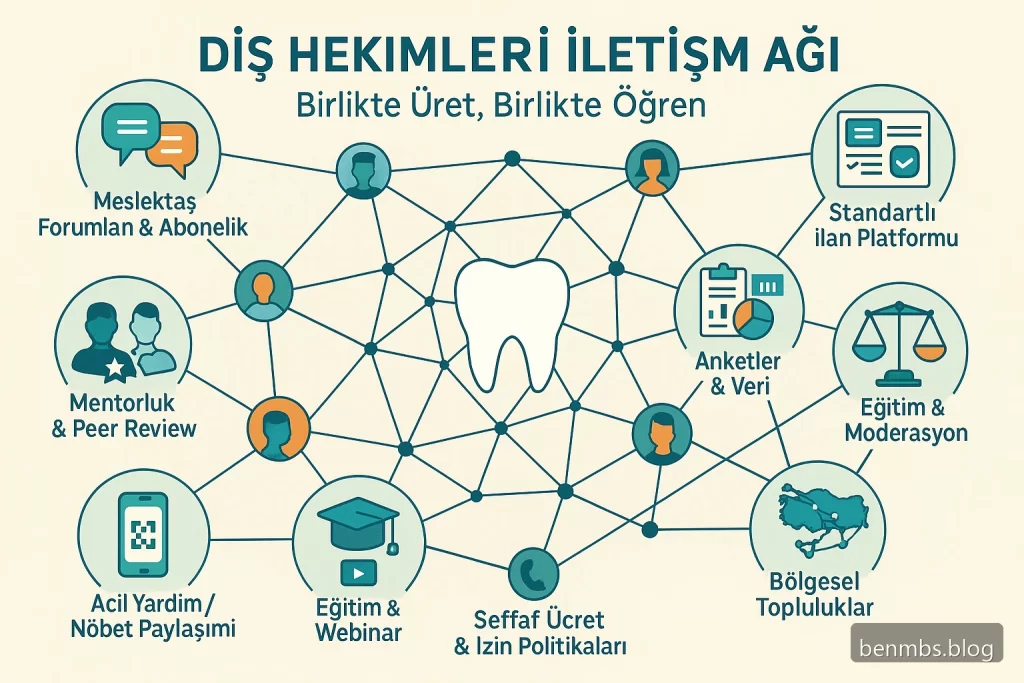
- There are things that could be done to strengthen communication networks among dentists. I mentioned above some of the problems dentists face. Even though these problems ultimately need to be resolved with legal guarantees, we also need in-system solutions until those legal guarantees are secured. To this end, I had made a proposal to Dentalilan about standardizing job listings, and they told me they were already working on it and would roll it out in a future update — but doing something at the chamber-and-association level seems to me like it would be more important and effective. And what could be done is clear: to borrow today's political jargon, we could launch our own "homegrown, national own-Dentalilan." What do I mean by this? We know the union or chamber is bothered by the problems dentists face. So why don't we set up a platform where the clinics that create these problems can't exist, and only clinics that meet certain standards can be listed? This way, job postings that fail to guarantee certain standards for patients and dentists alike wouldn't appear in front of us, and dentists looking for work could apply with confidence in the job they're applying to. Over time, this platform could evolve, or evolve directly into a social network. By evolving into a LinkedIn-like dental platform, it could become a structure where dentists can come together and organize. This way, the cries of dentists who've had their rights violated wouldn't get lost among Instagram posts and reels. Building and planning such a system is a subject for a separate piece, and of course for comprehensive research.
- A while back, I sent an email to a group pointing out that comments couldn't be left on the articles on their website, and that there was no subscription system for getting notified of new posts. I got no reply to the email. So I wrote to them on Instagram instead. I got a pretty polite response, and was even invited to their WhatsApp groups and so on. But the problems I mentioned, which could be fixed in 45 minutes, still haven't been fixed. Starting a blog is great, writing active content on it is even better, but for a professional association, isn't it a bit much to not even develop the system to a basic, Blog 101 level? The same goes for other groups. Most organizations don't even have a website, and when I do visit the ones that do, I can't really learn much.
- From what I've seen in my experience so far, I get along better with lab technicians. I can tell a technician about a mistake I made, so why can't I tell another dentist I work with in the clinic?
- Because some dentists and staff report on the dentist at every turn. This is explicitly requested by the boss himself. From the way they talk to a patient to the materials they use, the dentist feels under constant surveillance. Foucault has his depiction of the panopticon. Drawing on Foucault, I'd say: modern dental clinics are also a panopticon for dentists. It's a place where they feel watched at all times, yet don't know who's watching them, and so remain constantly on edge, treating everyone as a potential enemy, cowering. A friend of mine, for instance, was fired for using TheraCal in a root canal. The assistant complained to the boss, and the boss cornered my friend. Come on — does it harm the patient? No. Does it harm the clinic? What, 100 lira? At most. The guy had a momentary lapse and used TheraCal. Is that grounds for firing? Recently, my assistant handed me EDTA gel thinking it was etching acid, and I caught it during the procedure. I didn't even talk to her about it afterward. No need, really — as long as it doesn't happen again, that's enough, isn't it? Over time, these panoptic working conditions damage the employee's sense of belonging to the workplace, leading to cognitive fatigue, a decline in work quality, and ultimately, as the natural and most dangerous outcome of this process, alienation from one's own work.
- I don't know why — actually, I can guess — but there's a tendency among dentists to badmouth colleagues. It seems unlikely to me that some of the sector's problems can be solved without breaking this tendency, this culture of badmouthing. Looking at an X-ray of a root canal that doesn't look great, dentists can go straight to saying things like "who would call this a proper root canal." This feeds the culture of distrust we frequently experience with patients, at the dentist's expense. A patient who hears this stops trusting dentists altogether. This is one of the gangrenous spots in the system. Every day, someone comes into the clinic saying "doctor, is there a root fragment left in there," or complaining about another dentist. A patient who develops dry socket after an extraction designates the dentist as the culprit, rushes off to another clinic, and goes looking for a tooth root on the X-ray. I ask: did you smoke? They say yes. I say, that's not a root, that's leftover nicotine staining. We stare at each other for 5 seconds, and then…
Even if a root canal treatment did turn out badly, as every dentist knows, the real question is why it turned out badly. Maybe it was blocked, maybe it's patient-related, maybe it's a system-related issue? Maybe the dentist really did botch it, sure. But that's just one possibility among many. What should be said is something like "I don't know what was encountered during the previous treatment, but it's possible for this tooth to develop symptoms in its current state, and indeed you do have pain" — so why is the first instinct instead to say "this treatment was done like sh*t"? I think we have a problem with professional ethics.
- Because some dentists and staff report on the dentist at every turn. This is explicitly requested by the boss himself. From the way they talk to a patient to the materials they use, the dentist feels under constant surveillance. Foucault has his depiction of the panopticon. Drawing on Foucault, I'd say: modern dental clinics are also a panopticon for dentists. It's a place where they feel watched at all times, yet don't know who's watching them, and so remain constantly on edge, treating everyone as a potential enemy, cowering. A friend of mine, for instance, was fired for using TheraCal in a root canal. The assistant complained to the boss, and the boss cornered my friend. Come on — does it harm the patient? No. Does it harm the clinic? What, 100 lira? At most. The guy had a momentary lapse and used TheraCal. Is that grounds for firing? Recently, my assistant handed me EDTA gel thinking it was etching acid, and I caught it during the procedure. I didn't even talk to her about it afterward. No need, really — as long as it doesn't happen again, that's enough, isn't it? Over time, these panoptic working conditions damage the employee's sense of belonging to the workplace, leading to cognitive fatigue, a decline in work quality, and ultimately, as the natural and most dangerous outcome of this process, alienation from one's own work.
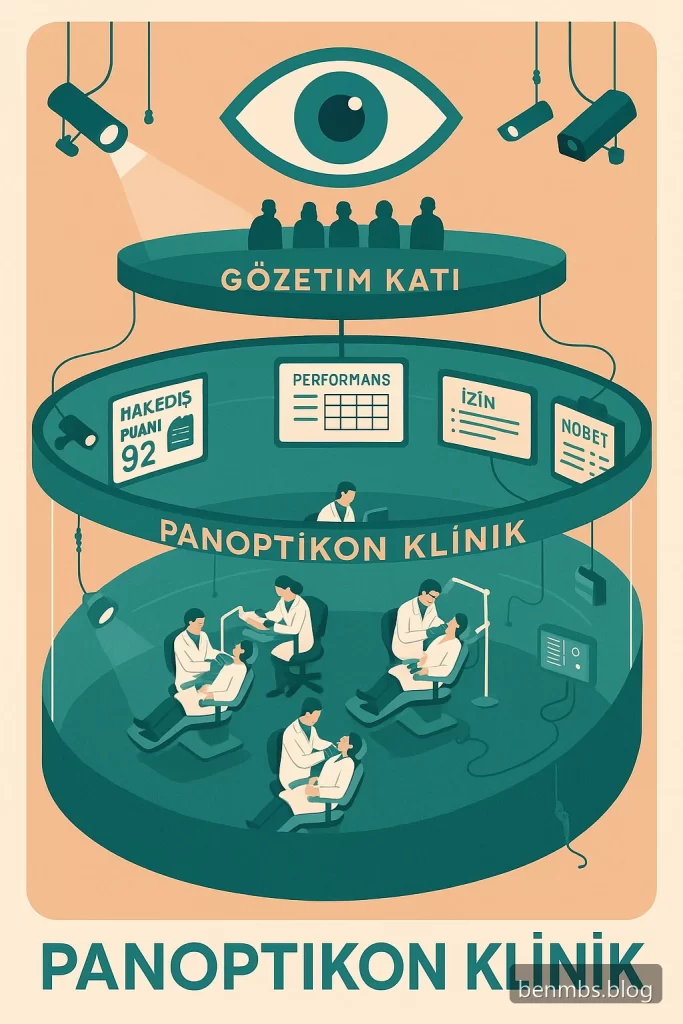
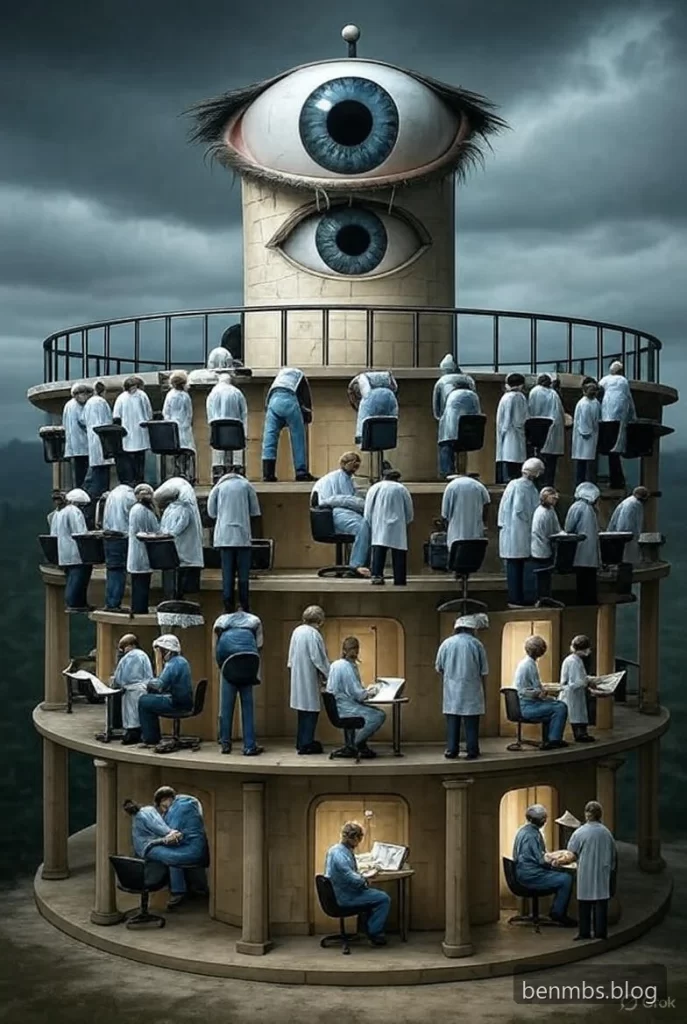
- In conversations among dentists, one of the first questions usually asked is whether the boss is a dentist, a technician, or an investor. But in my opinion, the real problem in the system isn't who the boss is — it isn't even unlicensed practitioners. The real problem for salaried dentists is other dentists.
- The perpetrators of many ethical and theoretical violations, too numerous to list here, were dentists. The people doing all of this were dentists. Technician-run clinics are a problem, yes, but what about dentists who never managed to become real practitioners?
- At a clinic I was forced to spend a few days at — and I'm not even getting into the many ethical violations I witnessed during that time — I was presented with a non-compete agreement that would bar me from working in half of Istanbul if I left the clinic. It was supposedly meant to prevent people from quitting, and if I left on good terms, the contract wouldn't be enforced. And of course, the person who put this contract in front of me called himself a dentist.
- There was a clinic that let me go on my 2nd day. Because they were trialing 2 people at the same time. The other person they were trialing apparently wasn't too keen on the clinic for personal reasons, which is why they decided to trial me as well. Then, once that person changed their mind and decided to stay, they booted me. This was a clinic co-owned by 3 specialists. The person who delivered my termination conversation was the front-desk receptionist. So, is the real problem really technician-run clinics? -Of course, that wasn't the only reason I got booted. A couple of mistakes I made may have played a role too [I say "may have" because I never got any feedback from our dear receptionist either]. But is there any other profession where an employee is let go the very first time they make a mistake? Why do dentists constantly have to stay on edge, perceiving threats everywhere?-
- Let's give another example from Dentalilan. Another problem that comes up is clinics looking for an "ortacı" dentist. What do I mean by this? In workshops, there are workers referred to as "ortacı" — they have no particular expertise; they fetch and carry for the master craftsmen at the bench and cater to their whims. If they're lucky, they get minimum wage. From what I've seen on the listings site, many dentists are looking, for their clinics, for a dentist to do "treatment" — meaning root canals, fillings, and scaling — in other words, an ortacı. Because the dentist wants to do the other, more "lucrative" procedures himself, and is looking for a laborer to offload the low-value grunt work onto for pennies. Now, isn't this a problem? And who's the problem here, if not dentists? A dentist wanting to see another dentist's hand before handing over big cases, and giving out work in a controlled way within a master-apprentice framework, is one thing; looking for an ortacı for your clinic is another thing entirely. The attitude I'm criticizing, and the one that deserves criticism, is the second one.
- I said somewhere above that I'd come back to the subject of business management. Let's get to that now, under this heading. As I mentioned in an earlier piece, we dentists spend our entire time in dental school learning the natural sciences, but we come away with no real grounding in the humanities and social sciences — things like finance, business management, and psychology. That's not our fault, but I still consider it a flaw. Because unlike physicians, we don't work within the structure of Hospital X. We open and run our own practice or clinic, but dentistry and business management are two entirely different things. Until we open our own place, the clinics we're exposed to and work in are, at most, clinics run by dentists just like us. How much can we really develop ourselves in business, marketing, or HR? Even if we switch jobs 10 times, we only ever pick things up informally, on the fly. And even that only happens if it's accompanied by the kind of maturity that comes with age. We sometimes spend years acquiring knowledge that could be learned in an intro-level business school course. And yet there's no need for us to bear the cost of rediscovering some of these things from scratch. An engineer, for example, can, in addition to what they learned in school, work at multinational companies as well as provincial factories over the course of their career; the people around them come from similar backgrounds, and over the years they pick up a business culture. We, on the other hand, simply can't gain this experience by virtue of our profession. And that's a problem, if we're going to be running businesses. I believe the way to overcome this is through education.
- I believe business management and marketing courses absolutely need to be added to the dental school curriculum. Even a basic grounding in business management and marketing would prevent many of the mistakes dentists have habitually made in their business practice.
- As far as I can tell, within the scope of continuing education, the chamber and association give us the chance to receive very valuable presentations and training on clinical practice from highly esteemed instructors, but alongside clinical training, business management training should also be provided. I think it would be extremely useful to cover topics like the importance of actually taking time off on official holidays, the possible effects of getting dentists reported on to management on company culture, whether undercutting on price and pulling in a patient that way ever actually pays off, and the ethical status of putting 2 dentists through a trial period at the same time and making them play Hunger Games against each other. As far as I've been able to follow, there are 3 people in our field who give training on clinical business management: Ahmet Kiğılı, Efe Çelebi, and Kübel Özkut. While I find what they do quite valuable in terms of multidisciplinary work, I think we should get our training directly from experts in the field itself. Alongside training from field experts, training from these dentist-background figures would also be beneficial, but the core of it, in my view, should come directly from people who've gone deep in this particular field — whether academics, holding-company executives, or otherwise.
- I believe business management and marketing courses absolutely need to be added to the dental school curriculum. Even a basic grounding in business management and marketing would prevent many of the mistakes dentists have habitually made in their business practice.
- The perpetrators of many ethical and theoretical violations, too numerous to list here, were dentists. The people doing all of this were dentists. Technician-run clinics are a problem, yes, but what about dentists who never managed to become real practitioners?
Conclusion
These are the problems I see in the field, and the solutions I propose for them. It's possible to elaborate on each point and examine it more carefully, but this piece, even as it is, has turned out much longer than I expected. Let's defer elaborating on these points to future pieces, and close things out by very briefly summarizing what we've covered so far:
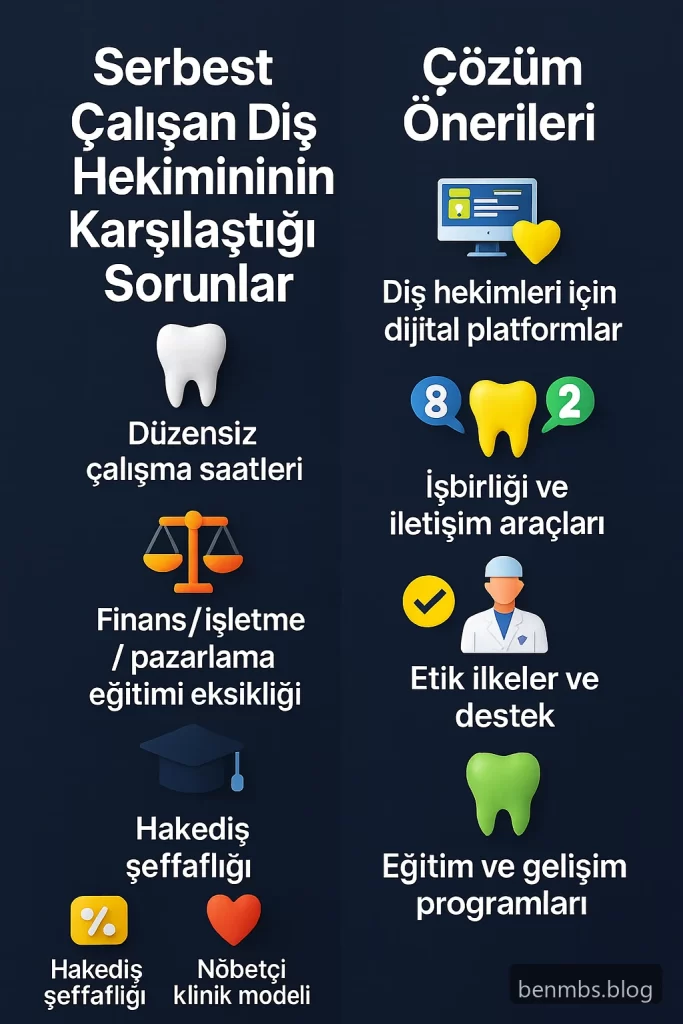
- Freelance dentists have problems too.
- Irregular hours / 6-day work weeks → An on-call clinic rotation system is a must.
- Difficulty taking time off → Business and sustainability training is needed.
- The boss–dentist–patient relationship is problematic; unpaid dues and loss of entitlements are widespread.
- Communication and organization are weak
- Professional groups' web/subscription/feedback infrastructure is inadequate.
- There are initiatives that remain scattered across Instagram/Twitter feeds.
- Even Dentalilan has more effective reach than the chambers.
- A "standardized listings platform" (a homegrown, national own-Dentalilan) should be set up under the umbrella of the Chamber/Association.
- There should be clinic acceptance criteria and a listing standard, providing assurance to both dentist and patient.
- Over time, it should evolve into a LinkedIn-like dental network (for organizing, visibility).
- Once all of this matures, I imagine professional organizations could even start functioning something like a guild.
- There are ethical problems.
- A culture of surveillance/reporting (panopticon) breeds inefficiency and fear.
- Badmouthing colleagues breeds distrust in patients; it's unethical.
- The problem isn't just "technician-run clinics"; dentists' own professional conduct also plays a part.
- Education gap:
- Finance/business/HR/psychology are missing at dental school. The Chamber/Association should offer management-focused training: holiday/leave policy, the impact of reporting on staff, price undercutting, the ethics of running simultaneous trial periods, etc.
- Training from field experts (academics/holding-company executives) is needed, plus support from dentist-background trainers.
Muhammed Batuhan Şahin
24.10.2025
[1] https://benmbs.blog/dis-hekimligi/dunyanin-butun-discileri-birlesin/
Don't miss new posts
Join the email list and hear about new writing as it lands.
Related posts
Dentists of the World, Unite!
The other day, while reflecting on the sorry fate of dentists, I came across a piece by Dr. Davut Torlak of the Social Dentists' Collective…
Exams, Plans, Realities: A Note to the Dream-Doctors Caught Between the Dental Specialty Exam and General Practice — Or, the Lines Behind the Last Photograph I Had Taken While Smiling at My Executioner
In the piece I wrote recently about the flow of time [The Man Whose Capital Is Melting Away], I mentioned I'd be sitting an exam. I sat it fifteen days ago, friends. The result? I failed. See: “We Didn't Make It, Boss”…
South Korea and Seoul: A Traveler's Stream of Consciousness and Travel Notes
Like the other posts on this blog, this piece won't be a travel guide answering questions like "where to go in Korea" or "Korea travel guide" — instead it will be an invitation into the mind of a traveler (I think this is the first time I've called myself that)…
Comments (0)
Be the first to comment.